“Werther” – a portrait of deep human emotions on the opera stage
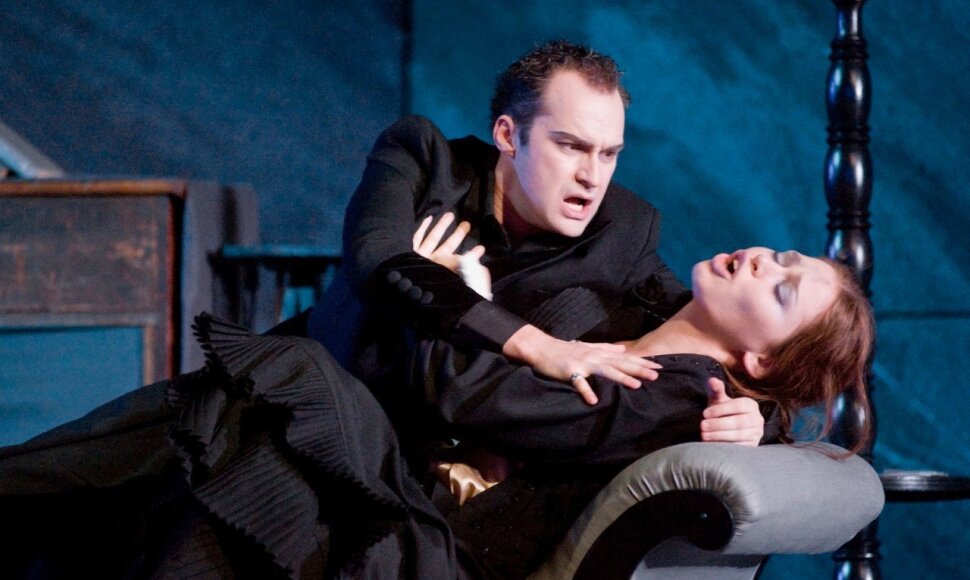
The anniversary journey through the most memorable works of Vilnius City Opera, which is celebrating its twentieth anniversary, will continue in Vilnius Town Hall Square on September 18 with Jules Massenet’s “Werther”. This is an atypical, chamber-scale VCO production that brought a Golden Stage Cross award to Edgaras Montvidas, who performed the leading role.
“Werther” became an exceptional work of the “Bohemians” – a psychological production with an enormous emotional charge and deep inner content. It was high opera, high music, high art, clearly and simply articulated through the dramatic language of theatre. For the “Bohemians”, it was a very unusual production, because until then all of their works had been spectacular and broad in scale. “Werther”, meanwhile, examined and observed the human interior, its psychology, with a minimalist yet exceptionally penetrating gaze.
It was precisely this work of French opera classics that inspired a separate direction in the creative work of the “Bohemians” – the “Gourmets” series. It featured carefully selected works that no one in Lithuania had previously staged, or had done so a very long time ago, such as Leoš Janáček’s “Káťa Kabanová”, Claude Debussy’s “Pelléas et Mélisande” and Camille Saint-Saëns’s “Samson and Delilah”.
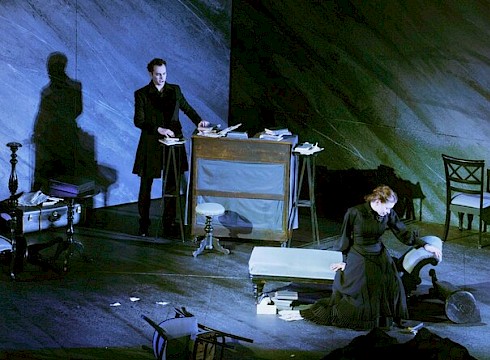
The Werther production, which premiered in 2008, was set within the abstract scenery of British scenographer Jon Morrell, which not only highlighted the drama of the main characters, but also the power of the talented soloists. It was not only E. Montvidas who revealed himself here. An impressive Charlotte was created by London-based Liora Grodnikaitė, and later also by Asmik Grigorian.
Edgaras and Liora, who were the first to create the roles of Werther and Charlotte, arrived at rehearsals not only with their vocal parts thoroughly prepared, but also having deeply analysed the work and bringing countless creative ideas. Their work together with director Dalia Ibelhauptaitė truly approached the creative process of drama theatre, where the idea and theme of the work became the central protagonists.
Laimonas Pautienius became practically irreplaceable as Albert in this production, colouring his performance with an incredibly broad emotional palette that convinced everyone. Lauryna Bendžiūnaitė, then still described as a debuting soprano, became the perfect younger sister of Charlotte.
Maestro Vladimiras Prudnikovas deserves a special mention here. His unexpectedly warm portrait of the father Bailli delighted audiences just as much as the portraits he drew right there on stage during rehearsals. It turned out that Lithuania’s most prominent bass had another talent – that of an artist. While rehearsing more complex scenes with a large mixed children’s choir, V. Prudnikovas, resting on a bench, created more than one sketch, which the Lithuanian State Symphony Orchestra, positioned very close to the stage and led by maestro Gintaras Rinkevičius, could never wait to see. Later, V. Prudnikovas’s student Tadas Girininkas took over his teacher’s role, while long-standing members of the troupe Kęstutis Alčiauskis and Rafailas Karpis could also be seen on stage.
“Werther” also featured exceptional soloists who had mastered the complex intricacies of French music. Tenor Andrew Richards’s appearance was a true gift to the audience. The American soloist was so deeply impressed by the “Bohemians” ensemble of that time that he even appeared in one of Lina Fisheye’s legendary photo sessions created to capture and summarise the troupe’s activities at the time.
Vilnius audiences also had opportunities to encounter the impressive baritone of Lars Møller (Denmark) and Wendy Dawn Thompson, who came from faraway New Zealand.
Juozas Statkevičius, who created costumes that at first glance appeared consistent and unremarkable in their shades of grey, surpassed even himself. Every costume was distinguished by intricate details, appliqués, cut-outs and textures. It is hard to believe how rich and diverse the colour grey can be! The expressionist palette of emotions in the visual side of the production was vividly conveyed by the lighting created by Peter Mumford, who painted the stage with light as though it were a picture.
In such a seemingly - and even deceptively - minimalist production, another painting dominates its grey tones, as though created with expressionist brushstrokes: the canvas of Werther’s inner emotions painted by J. W. Goethe and J. Massenet. As soon as Werther’s story was created, “The Sorrows of Young Werther” (1774) shocked society and became a behavioural model for many young people who were also prepared to die for love. They dressed in “Werther-style” clothing – a blue coat and yellow breeches, wrote long, passionate letters, composed poetry and immediately recited it. Goethe’s novel sparked a genuine movement, and sadly, dying for love became thrillingly fashionable.
D. Ibelhauptaitė’s “Werther” was deeply loved by audiences; the ensemble received a great many letters filled with impressions and enormous emotions. And this is not surprising – after all, modern people also want to be romantic; they feel a longing for the genuine feelings, passionate love and devotion characteristic of the nineteenth century. Werther’s love is unconditional; he goes all the way, gives himself completely and destroys himself for the sake of love.
In our twenty-first century lives, where digital experiences substitute for genuine feeling and communication, such unbridled passion is extraordinarily compelling. Looking at the dreamer Werther, each of us wants to see a part of ourselves, believing that we too could love and sacrifice ourselves in such a way. Watching Charlotte’s hesitation, we probably remember ourselves in our youth, when we had to choose between desire, passion and a safe, comfortable life.
The project is funded by Lithuanian Council for Culture and Vilnius City Municipality.
Related news
Bohemians Turn 20: Anniversary Season to Culminate in Norma with Asmik Grigorian
Sustainability in opera: how Juozas Statkevičius’s costumes were given new life a decade later
When everything hangs in the balance on stage: the invisible heroines of Dalia Ibelhauptaitė’s productions reveal the secrets behind the scenes
How Bohemians’ advertising took to the streets and changed perceptions of opera