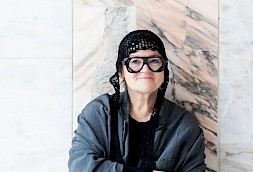
When everything hangs in the balance on stage: the invisible heroines of Dalia Ibelhauptaitė’s productions reveal the secrets behind the scenes
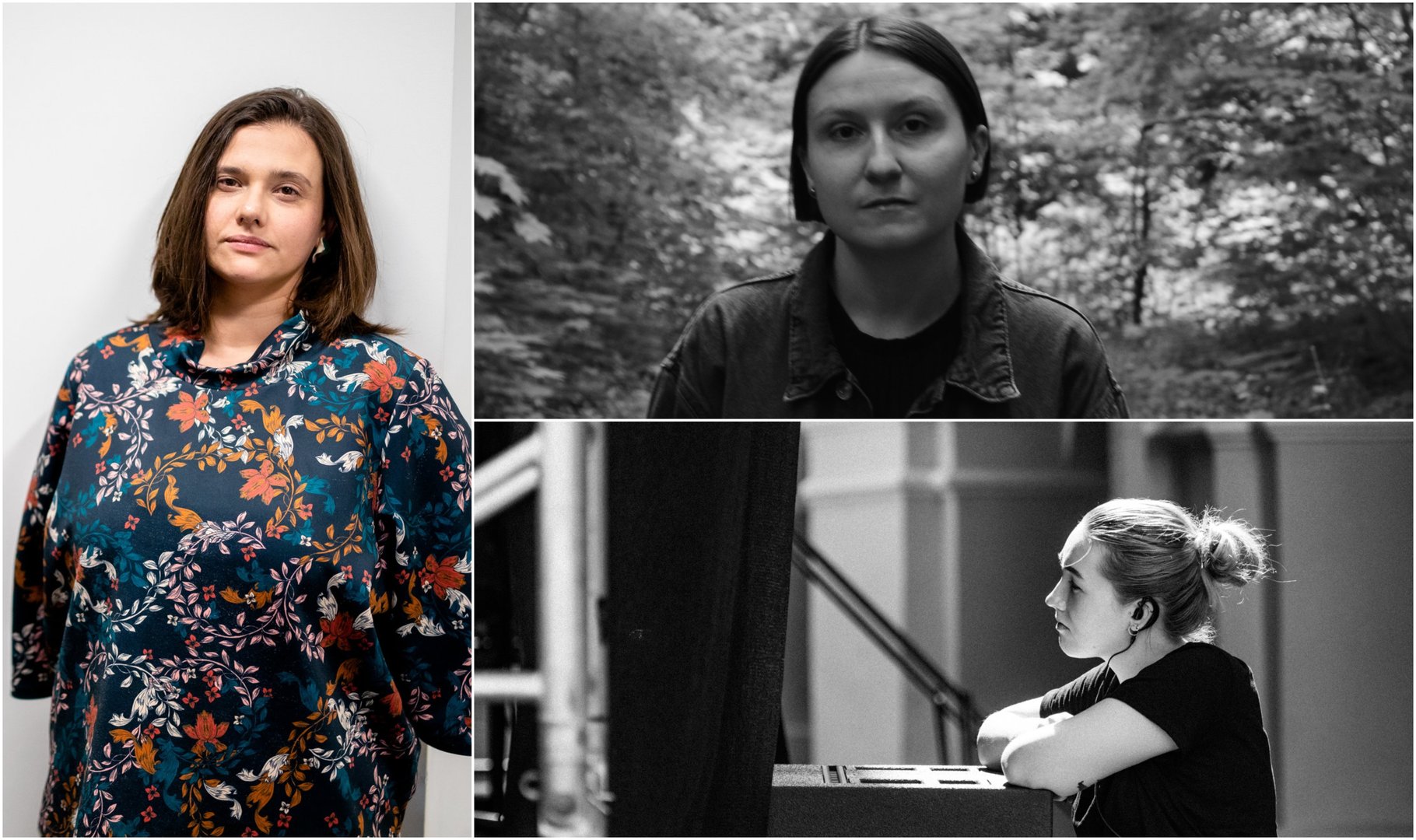
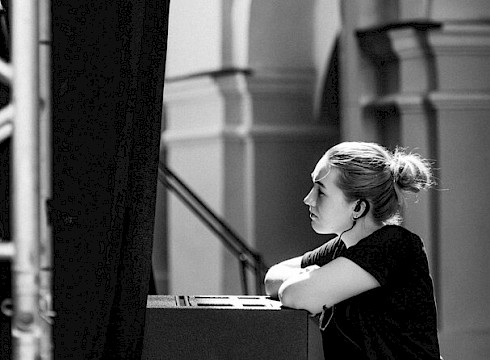
Stage art is a miracle, and behind it lies an enormous amount of invisible work. The audience sees the soloists, the conductor, the sets and the lights. Yet almost no one knows that every change of lighting, every movement of the scenery, and every soloist’s entrance onto the stage is controlled by a person sitting in the darkness with headphones and a score.
In the West, this person is called a stage manager, while in Lithuania, just twenty-five years ago, the profession simply did not exist. It emerged thanks to Dalia Ibelhauptaitė and grew together with the “bohemiečiai”.
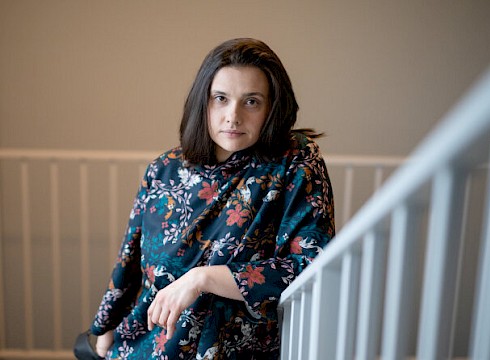
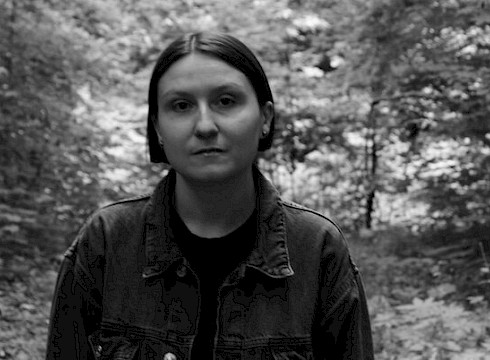
As the “bohemiečiai” celebrate their twentieth anniversary, we talk about the work without which not a single curtain could rise with the director and three professionals who spent many years working behind the scenes: Sigita IVAŠKAITĖ, Ieva SAKALYTĖ and Augustė STULPINAITĖ-VASIONĖ.
“All the Universities in a Single Production”
This story does not begin on the “bohemiečiai” stage, but at Trakai Castle. In the summer of 2001, Dalia Ibelhauptaitė staged G. Verdi’s Un Ballo in Maschera there, her first production in Lithuania, created for the Vilnius Festival. After a decade working in British and European opera houses, she discovered one thing very quickly. “Neither the Lithuanian opera nor the drama theatre had people who were called stage managers in the West. And there, every production - especially complex operas - needed at least three of them,” the director recalls. “I arrived in Trakai for rehearsals, asked where they were, and everyone looked at me with a completely blank expression.”
The principal stage manager, D. Ibelhauptaitė explains, is responsible for running the entire production. They know all the lighting changes, projections, movements of the scenery, and the trajectories of every soloist and chorister on stage. They even map these movements out according to the music in every scene so that everything can be recreated if necessary. “They are like a train dispatcher or an air-traffic controller, making sure the planes don’t collide.” They are assisted by people stationed backstage on the left and right sides of the stage. They help performers who are about to go on stage, hand them props, and keep an eye on everything.
Such people had to be found urgently, among employees already working in other positions at the same theatre. The first was prompter Giedrė Rubežienė. “She officially became the first representative of this profession in Lithuania,” Dalia says. “She had to learn everything at tremendous speed, and, my God, there was so much to keep track of in Trakai! It was like all the universities in a single production.”
The scenery had to be transported by water, but there were no pontoons capable of carrying such weight, so no one knew whether the sets would sink. Once the stage was assembled, it became clear that it was too small and there was not enough room for the lights. Televisions borrowed from Lithuanian Television and the National Opera buffet were supposed to serve as monitors. “It started raining, and nobody thought to cover them with some kind of plastic sheeting. Whenever we switched them on, they would simply explode,” the director recalls. “The producer managed to escape all that stress, while Giedrė held the entire production together in her hands.”
“There’s Sigutė”
Giedrė came with Dalia to the Palace of Congresses as well, where the first “bohemiečiai” Boheme was born in 2006. But it quickly became clear that one person was not enough for this profession. From the second production, The Magic Flute, Sigita Ivaškaitė joined the team and eventually became the principal production manager for “bohemiečiai” performances.
She had been connected to the opera world since childhood. She attended the amateur dance ensemble “Polėkis,” based at the Lithuanian National Opera and Ballet Theatre, and, together with the other girls, took part in performances as an extra. “We were sort of half-actresses, so when they went on tour and couldn’t just take anyone to ‘stand behind a tree,’ they took us too,” Sigita recalls. During one such tour, she was sitting behind Giedrė Rubežienė and overheard her asking Sigita’s dance teacher: “Do you know anyone with a good head on their shoulders? I need some help - Dalia is going to stage another opera.” The teacher turned around and pointed at her. “There’s Sigutė.”
Sigita had no intention of pursuing dance. She was already preparing to study theatre criticism, so the offer seemed interesting. She immediately understood, however, that she would have to read music. “I only had the most basic knowledge, so I got a copy of the piano-vocal score, turned on a recording and taught myself to follow the notes. I practically memorised the first opera out of fear, because I had no musical education.” She learned from Giedrė and Dalia - from what they asked of her and how they formulated their tasks. “A lot of things in theatre don’t emerge from formal education. First there is a need, then someone adapts to it, and only afterwards is the technique refined,” Sigita says. “Dalia brought the need, one person adapted to it, and others followed.”
Sigita honestly cannot remember which production she conducted for the first time herself. What she does remember is something else. “One time after a performance I was very tired, and Dalia looked at me in such a way that I realised: at that moment, she had decided I could already do everything myself. And she asked whether I could take over. I already knew her a little by then, so I understood that her question wasn’t really ‘could you?’ but ‘when can you start?’” Soon Sigita was also invited to work at the Lithuanian National Opera and Ballet Theatre, where a Lithuanian name for the profession eventually took root: spektaklio vadovas - production manager.
“The production begins and ends with us”
Even today, however, there is no single established title for the job. Ieva Sakalytė, who worked with “bohemiečiai” for five years, calls herself a pastatymo vedėja - production manager - while, as Augustė Stulpinaitė-Vasionė recalls, the programme booklets for a long time referred to them as stage assistants. The essence is the same. “It is the person who controls the course of the production: during the performance, they give signals telling the soloists when to go on stage, when to change the scenery and lighting,” Ieva explains. “Of course, they also work during the preparation stage: they familiarise themselves with the production’s vision and the creative team’s decisions, take part in rehearsals and lead them.”
An opera usually has one senior production manager, known in English as the caller. They sit at a console with numerous buttons, communicate with all the technical departments, and, following the score, give cues for the lighting and scenery.
“Unlike drama, in musical theatre everything is tied to the music, while the technical staff do not necessarily know how to read music,” Sigita says. Another two or three people work backstage.
“One scene is taking place, and they already know what is going to happen two scenes later. They check whether people are ready to go on stage at the right moment, whether all the necessary items are there, and help with quick costume changes. Essentially, the production begins and ends with us. We invite everyone onto the stage, check that everyone is ready, and give the signal that the conductor can enter. And when everything is over, we organise the bows and lower the final curtain.”
According to Sigita, the job requires endurance, composure and extremely steady nerves, as well as time-management skills, precision and spatial awareness. “The most important thing is to understand a problem quickly and immediately move towards a solution rather than discussing it. Backstage, a soloist may arrive when they practically need to be on stage already and say they are missing some part of their costume. By the time they finish the sentence, you should already be halfway there, because you need to know where that item is for them.” Ieva adds: “Anything can happen during a performance, so it is important not to lose your head, not to give in to stress, and not to pass that stress on to the team working backstage.”
Breathing together with the conductor
British lighting designer Peter Mumford, who worked with “bohemiečiai,” knows the profession well: his partner worked in the same job for many years. “He always used to say that only women could do this job, because only they had that kind of precision, attentiveness, thoroughness and sensitivity,” Sigita says. “From the outside, the job looks dry and technical, but it requires enormous sensitivity to the music and the director’s idea.
It’s not simply about mechanically saying when the scenery should move. You have to understand that at that particular moment you need to breathe together with the conductor and give the cue slightly before he lowers or raises his hand. Then the scenery seems to breathe together with the music.”
“Guilty Augustė”
In 2015, Vilnius City Opera announced that it was looking for assistants. At the time, Ieva Sakalytė was studying video directing at the Lithuanian Academy of Music and Theatre and wanted to become a film and television director, so she was unsure for a long time whether she would even be invited to an interview. “But since childhood, thanks to my mother and father, I had been fascinated by music and opera, so I was genuinely curious simply to see what the backstage world of opera was like.”
She started with Pelléas et Mélisande, learning everything from Sigita and observing her backstage assistants until she was eventually offered the position of production manager. The first performance she led was Charles Gounod’s Faust, in which the entire backstage staff had a great deal to do. “I remember trying with all my strength to remain calm, even though everything inside me was boiling and pounding, just so I could give all the cues on time.”
That same year, political science graduate Augustė Stulpinaitė-Vasionė also responded to the advertisement. She had no theatre experience, but she knew she wanted to work with Dalia Ibelhauptaitė. Sigita invited her to an interview. “She later admitted that she was very curious to see what someone who had graduated in political science, could read music because I played the piano, and was preparing to go work in a casino looked like. I was actually supposed to start working there at the time!” Augustė laughs. Instead of a casino, she found herself at rehearsals for Pelléas et Mélisande, and in 2016 she was invited to work on Eugene Onegin. “That was a true trial by fire, water and brass.”
For many years, she worked as an assistant on the most complicated backstage side of the Palace of Congresses. “You think about everything: whether the soloists have all the props they need, whether they know where their costumes are, when they need to be with the others. We would even make arrangements with the soloists: ‘I won’t be able to run and get you at this moment, so during the interval wait for me here.’” From the outside, it resembles the work of a kindergarten teacher, and which Augustė does not deny.
“A little, yes! But it is an incredibly rewarding experience, because you work with absolute professionals in their fields: the Kaunas State Choir, Lithuanian and foreign soloists. They show a great deal of respect because they understand that without us, everything would be much more complicated.”
During the pandemic, Dalia introduced everyone who worked with her during Facebook live broadcasts, and Augustė acquired the nickname “Guilty Augustė.”
“If anything bad happened, just know that Augustė was to blame. And, to some extent, that really was the case!” The most memorable incident for her also involved Faust. During one performance at the Palace of Congresses, Mefistofeles, played by Almas Švilpa, had to enter the stage carrying a dagger. “I put the dagger in his dressing room, but I didn’t actually hand it to him. A duel is supposed to happen, Valentin is supposed to be stabbed, and there is no dagger. I didn’t see any of this myself. I only heard over the headphones the production manager sitting at the console asking: ‘Where is Faust? Why did he run out?’ Faust had run backstage expecting me to be there and hand him the dagger. But I wasn’t there.” The situation was saved by Laimonas Pautienius, who played Valentin. He pretended to clumsily drop his own dagger, and Edgaras Montvidas, playing Faust, grabbed it and used it to stab Valentin. “It seems I later gave Laimonas some kind of gift as a thank-you, because I really didn’t know what else to say.”
“How are we going to do it?”
Working with Dalia Ibelhauptaitė demands a great deal. With an independent company producing performances on such a large scale, working through the night was not unusual. “We have worked all night practically without sleep,” Sigita recalls. “Knowing the scenery well, I found a corner where I wouldn’t get in anyone’s way because the lighting technicians were still working, and I lay down and dozed for a little while. That probably shows just how much energy we all invested, believing and knowing that it had to be done.”
According to her, when working with Dalia, the question of whether something will be possible never arises. “When she plans something, she doesn’t ask what we will do if it doesn’t work. Her question is always: ‘How are we going to do it?’ You feel both trust and a certain kind of pressure that is difficult to explain. Normally, when someone pressures you, it seems that they don’t believe in you. But Dalia’s pressure is about the fact that if she has asked you to do something, she has already envisioned that you are capable of it - and you have to go somewhere inside yourself and find resources you didn’t even know you had.”
What Sigita remembers most are not particular incidents, but the people Dalia brought in from other countries. “Their approach was less vertical and hierarchical, more horizontal, based on trust. That was exactly what I was missing in our theatre at the time, which had once been built on the Russian system. You came away from those productions with the understanding that you could do things, and with a beautiful sense of relationships: we are all professionals here, we trust one another and we respect one another.” She laughs that Dalia has a secret project for every person who works with her for a longer period of time. “She saw in many of us, from the very beginning, what those people could grow into. If you work with her for a long time, it means she has a project for you - she just started it very quietly ten years ago.”
For Augustė, Dalia has always been an enormous authority. “I was a little afraid of her too, because when she is completely focused on a production, she is very strict, demanding and knows exactly what she wants. But there is also a lot of motherliness in her. She always responded to us with great sensitivity and empathy. You have just received criticism because something went wrong, and a moment later, during the premiere, she is greeting my parents and saying: ‘Your child is a miracle, simply an angel!’ That contrast between strictness and the enormous love she has for everyone who works with her - that is Dalia.” Ieva remembers the people first and foremost. “The ‘bohemiečiai’ always attracted very hardworking, clever and creative people. Over five years, all kinds of situations came up: something needed to be repaired quickly or a solution had to be found. And we always found one.”
Applause that isn’t needed
The production manager never comes onto the stage to take a bow. Doesn’t she miss that? “I joke that I studied for six years so that I could be invisible,” Sigita smiles. Today she works primarily in theatre criticism and dramaturgy. “There are people who enjoy everything that happens before going out into the public eye, while the actual appearance in front of an audience is someone else’s fulfilment. For some people, it feels very good to stand in a dark corner and know that those applause are also for you - you just don’t need to physically collect them.
If you did your job well, when the curtain comes down and you go to help a soloist because they can’t carry all their flowers, help them change or walk back to their room, their warmest ‘thank you’ is all you need to know that you did a good job that day.”
For Augustė, the greatest recognition was also not the audience’s applause. “When someone as an absolute star as Asmik Grigorian comes and hugs you after the performance and says, ‘Thank you, we worked wonderfully together,’ you understand that a person who has seen so many performances, companies and teams does not say that without meaning it.” After the pandemic, she completely changed her professional path and is now a team leader at Vinted.
Ieva is now what she always wanted to be: a freelance film and television director. “To be honest, I never thought about applause. Everything felt so natural and interesting. It was simply good to be part of it.”
Dalia Ibelhauptaitė, however, speaks about this profession without any reservations: “Without this person, no production can take place on stage. None at all. Everything depends on their professionalism, vigilance, enormous mental and psychological effort, and patience.”
Related news
Bohemians Turn 20: Anniversary Season to Culminate in Norma with Asmik Grigorian

Sustainability in opera: how Juozas Statkevičius’s costumes were given new life a decade later
How Bohemians’ advertising took to the streets and changed perceptions of opera
Dalia Ibelhauptaitė: if I don’t fit into the clothes, there are always beautiful shoes!