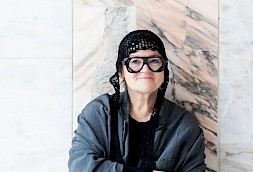
Sustainability in opera: how Juozas Statkevičius’s costumes were given new life a decade later
Today, sustainability has already become part of our everyday lives. Not only at home but also at work, we try to make more conscious choices and protect our environment. But have you ever stopped to think about what sustainability means in the theatre?
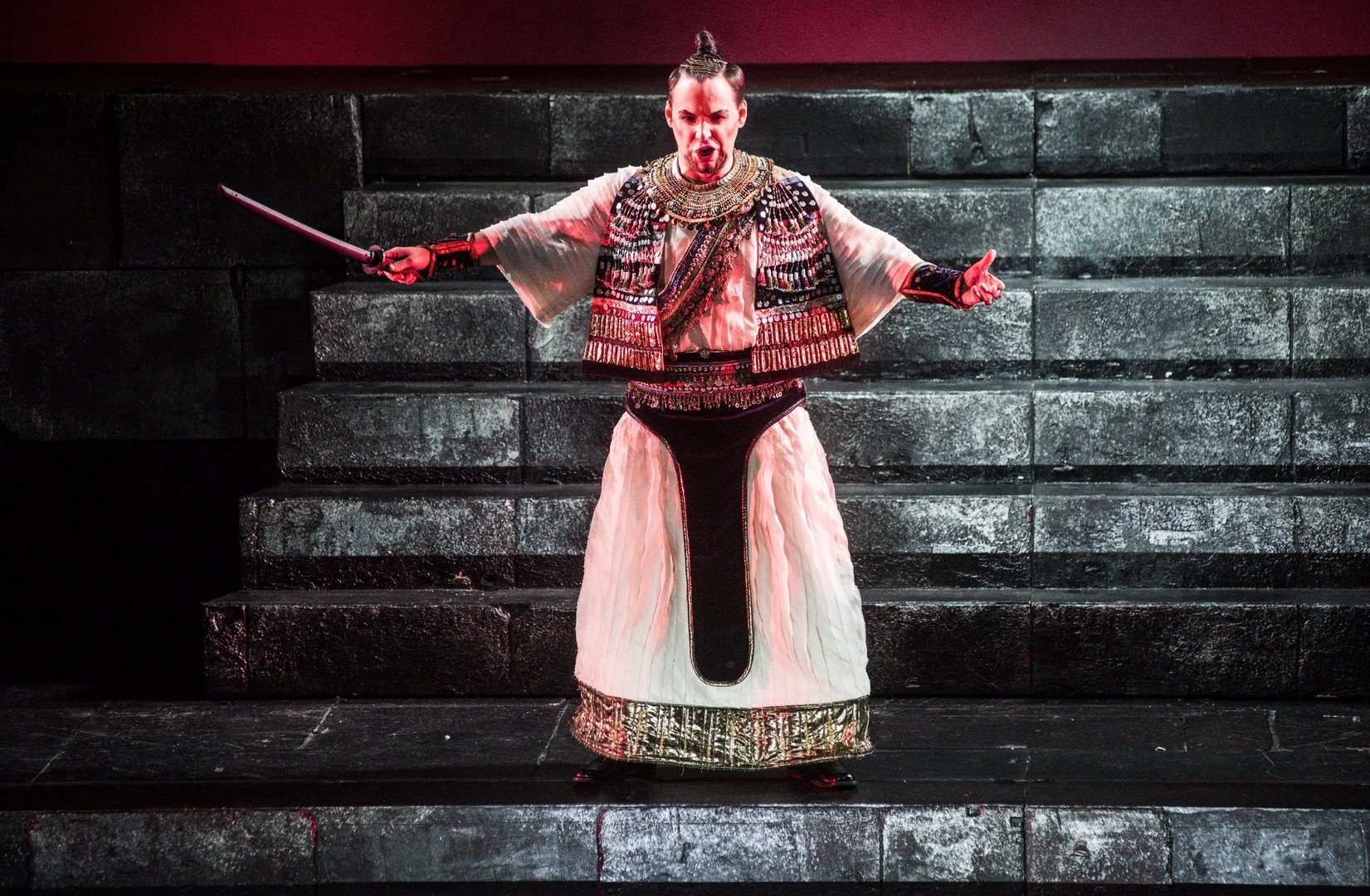
To this day, many different approaches are being explored: incorporating sustainability principles into the organization of rehearsals, reusing elements of sets or costumes, and even turning the performance itself into an activity that generates its own electricity. In 2017, Vilnius City Opera presented Camille Saint-Saëns’s Samson et Dalila, the continuation of its “Gourmet Series,” with its visual concept based on the sets and costumes of the production of The Magic Flute, which had premiered a decade earlier.
How and why did the company make such a decision at a time when the principles of sustainability had not yet been widely adopted and were practically unheard of in theatres?
According to director Dalia Ibelhauptaitė, the “Gourmet Series” was never the most profitable project. Attracting audiences to twentieth-century opera is considerably more difficult, and the primary objective here is not sales, but rather the opportunity to introduce audiences to works that are highly regarded around the world yet rarely, if ever, performed in Lithuania. In this way, the artists seek not only to raise their own standards of quality but also to create conditions in which the audience’s tastes can develop.
Another aspect of survival for an independent opera company without its own premises is the question of storing sets and costumes. Where do you keep enormous stage designs when you do not have a single large space of your own? Or several hundred costumes for each production?
As the repertoire grows and the number of productions increases, this becomes an increasingly pressing issue: how can one preserve the sets of works that are rarely performed or have already completed their stage life? And, more importantly, can the enormous amount of resources, labour, creativity and expense invested in these works be put to further use?
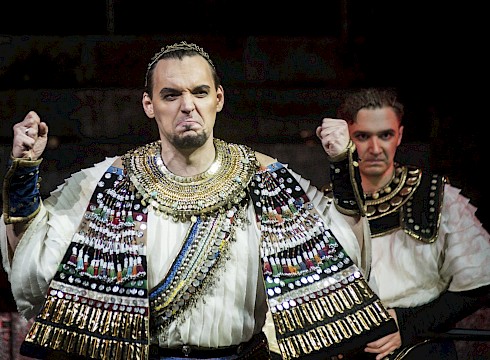
The Magic Flute entered the VCO repertoire as one of its most visually spectacular productions, particularly because of the costumes created by Juozas Statkevičius, hand-sewn from thousands of buttons, complemented by performers’ faces dusted with gold powder. And then there were the hundreds of wigs brought to Vilnius in suitcases!
Meanwhile, Dick Bird’s set design, which created the monumental image of the Egyptian pyramids, could astonish with its functionality and its numerous possible combinations, changing like variations of a Rubik’s Cube. Yet after a decade, the production itself had fulfilled its mission, while Samson et Dalila was waiting for its own visual solution.
Interestingly, precisely because of its enormous scale, C. Saint-Saëns’s opera had difficulty finding its way onto the stage from the very beginning. Classified as a grand opera, the work required not only a huge orchestra and extensive preparation, but also a wealth of set and costume elements and a ballet interlude - all of which remain challenging in the expensive world of opera to this day. Evidence survives that the first Samson et Dalila premiere at the Metropolitan Opera in 1895 was in fact presented using sets that had already been created and used in earlier productions, while the British premiere was limited to a concert performance.
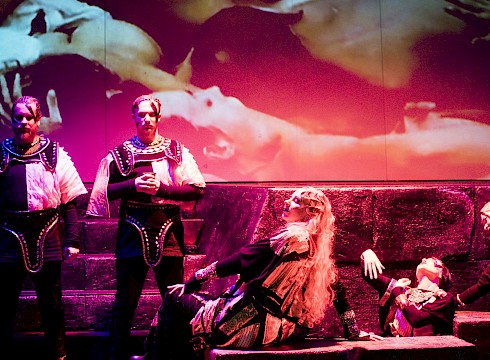
This was where the creativity of the VCO company revealed itself in finding solutions to the most difficult situations. Taking as their starting point the timeless story of the opera - one that is not confined to any particular period - they chose to adapt and fundamentally deconstruct the set of The Magic Flute and its legendary costumes. A decade later, and after as many as 29 successful performances of the opera, the stage costumes were completely reimagined.
“Costumes of such detail, craftsmanship and uniqueness as those created by Juozas are extremely complex and expensive one-of-a-kind works, so it is very important that their lives should be long-lasting and, in some cases, even go through several ‘reincarnations,’” D. Ibelhauptaitė explained at the time. The set, meanwhile, underwent a complete transformation of colour - it was painted black - while the architectural compositions created by its forms unfolded in the reverse order from those in The Magic Flute.
VCO did not simply reuse its works of stage art; it completely rethought them, creating a new interpretation that helped convey the specific themes of Samson et Dalila.
One of the most “gourmet” of operas made it possible not only to collaborate with past productions but also to invite a variety of artists and intellectuals to engage with and interpret the story through their own work. The production poster featured an image from a painting by Andrius Zakarauskas, depicting a kissing couple and, in the distance, the silhouette of a man raising his hand. In breaking down the elitism associated with opera, VCO also made painting accessible to a wider audience - while at the same time drawing the attention of artists, critics, gallery owners and curators.
The painting that became the face of the production finally fulfilled a long-held dream of D. Ibelhauptaitė, after a lengthy search for the right painter. At the same time, it represented a significant step in the history of Lithuanian theatre-poster design. Archives contained posters that could have become independent works of art, or vice versa, paintings that could have served as posters, yet at the time this seemed like a long-forgotten tradition.
“I am interested when a painting or an image contains many references and many question marks: why is it this way, why is it different, what period does it belong to? Is it the past or the future, or is it always like this...? Like the Last Supper. When did it take place? Two thousand years ago? Or perhaps it is happening continuously? Perhaps that situation is still happening today.”
“All those references and question marks that emerge in this painting are incredibly important to me,” A. Zakarauskas said of his work, admitting that it was his first time creating for the theatre and that he had never imagined that he would end up there not painting scenery, but instead creating an image that would come into being immediately before the performance itself.
We all know the story of Samson et Dalila as a tale of love and betrayal, and we often forget all the circumstances surrounding it. “First of all, to me this is a political story: a struggle between nations carried through to the bitterest end, to mutual destruction - a story rooted in different beliefs, traditions and ways of seeing the world. This is a struggle over differences, and there is no morality or decency here - no rules of honourable combat. There is only one goal: to win and destroy the other side through a dishonourable, underhanded and, I would even say, terrorist struggle,” D. Ibelhauptaitė has said, arguing that the story of Samson et Dalila is in fact entirely contemporary, telling of the experience of millennia-long conflict between two nations.
Within this creative process of rethinking the opera’s plot, themes and their significance, the sets and costumes, effectively evaluated for a second life, revealed the possibilities of the new interpretation even more vividly. They were complemented by profound texts by authors such as Kristina Sabaliauskaitė, Donatas Puslys and theologian Dr. Monsignor Visvaldas Kulbokas, published in the programme.
By applying the ideas of sustainability to its visual solutions, VCO’s creators were able to devote greater attention to the content of the performance itself and to the way it was presented, offering audiences an entirely different opportunity and experience - perhaps allowing them, for the first time, to discover a true diamond of French opera.

Related news
Bohemians Turn 20: Anniversary Season to Culminate in Norma with Asmik Grigorian

When everything hangs in the balance on stage: the invisible heroines of Dalia Ibelhauptaitė’s productions reveal the secrets behind the scenes
How Bohemians’ advertising took to the streets and changed perceptions of opera
Dalia Ibelhauptaitė: if I don’t fit into the clothes, there are always beautiful shoes!