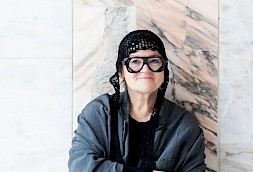
How Bohemians’ advertising took to the streets and changed perceptions of opera
A television host who has bird droppings fall on him live on air. Opera singers playing chess in a bathtub. A director selling tickets at the Kaziukas Fair. For twenty years, the advertising of the Bohemians, who later came together as the Vilnius City Opera (VCO) theatre, reached people in places where they least expected to encounter opera. It invited audiences to discover the art form through everyday experiences, humor, and provocation.
“Twenty years ago, I met Dalia Ibelhauptaitė. Against my will,” communications consultant Kristinas Taukačikas recalls with humor when remembering how he first became acquainted with the Bohemians.
He was invited to contribute to the publicity campaign for Giacomo Puccini’s La Bohème, which was being staged in 2006, by Mikas Feigelovičius, then head of the advertising agency DDB Vilnius. K. Taukačikas admits that he knew very little about opera, but after meeting the director, he unexpectedly agreed to help. Later, he found himself organizing unusual ways of presenting performances and even appearing on stage himself.
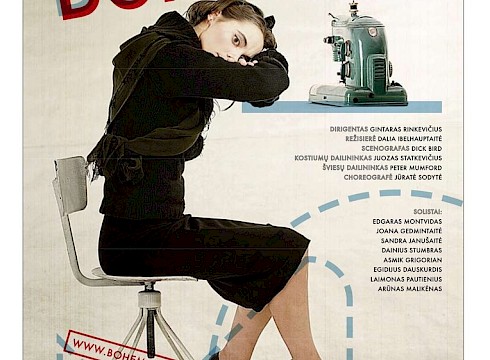
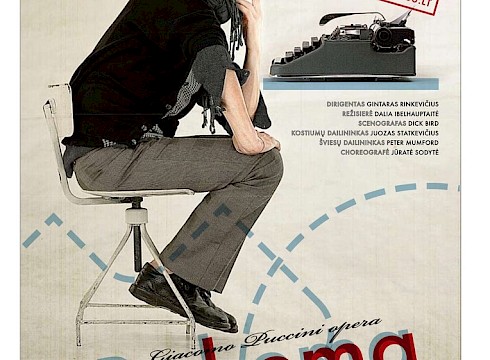
The first La Bohème advertising campaign was created by DDB Vilnius. In the 2006 posters, a young woman leans over a sewing machine, while a man sits at a typewriter - philosopher Viktoras Bachmetjevas served as the model for him. Another design showed a group of young people gathered in a café. Audiences were introduced to the opera’s characters through familiar details of everyday life: work, surroundings, and relationships.
The premiere, held on October 25 at the Vilnius Congress Palace, brought together people whose community would later take the name inspired by the production. K. Taukačikas recalls that the name “Bohemians” was born in a Žvėrynas café, on napkins, while he and the director discussed plans to stage other productions after La Bohème. According to him, then, as now, they had neither their own premises nor permanent funding. Dalia Ibelhauptaitė and a core group of talented singers were united by shared values and a desire to create opera in a new, relevant, and engaging way. “After the first production of La Bohème, a movement was practically born, and it needed a name,” K. Taukačikas recalls.
The first campaign was visible throughout the city: for several months, a trolleybus completely covered in La Bohèmeadvertising travelled around Vilnius. Ibelhauptaitė recalls deliberately choosing a long route that ran across the entire city. Lietuvos rytas devoted full pages to advertising the production and publishing articles about it, following the example of The New York Times and The Guardian - on a New York scale, as the director puts it.
The La Bohème programme came with a handkerchief. Ibelhauptaitė recalls President Valdas Adamkus’s reaction: such a programme would have to be kept in the display cabinet. According to the director, this marked the beginning of a tradition of creating programmes that audiences would want to keep as souvenirs of the performance.
K. Taukačikas tells the story of the Bohemians from the perspective of a communications professional. The co-founder of what was then Public Relations Partners, which later became the agency Fabula, says that people joined the Bohemians by being invited by one another. This was often how creative partners, sponsors, and suppliers came on board.
“A colleague from the advertising industry asked me to help the Bohemians with public relations, and later I asked other advertising agencies to get involved. That is how a communications machine got going, powered by most of the country’s best agencies and the people working in them,” he recalls.
One example was the Milk Vilnius team, led by Marius Petrukaitis, which proposed the idea of a notebook for Werther. The personal format of the notebook suited a story about love and inner emotions, while the memory of the opera could be taken home and kept. At the “ADrenalinas 2009” festival, the Werther programme won an award in the design solutions category, while the entire campaign won in the advertising campaign category.
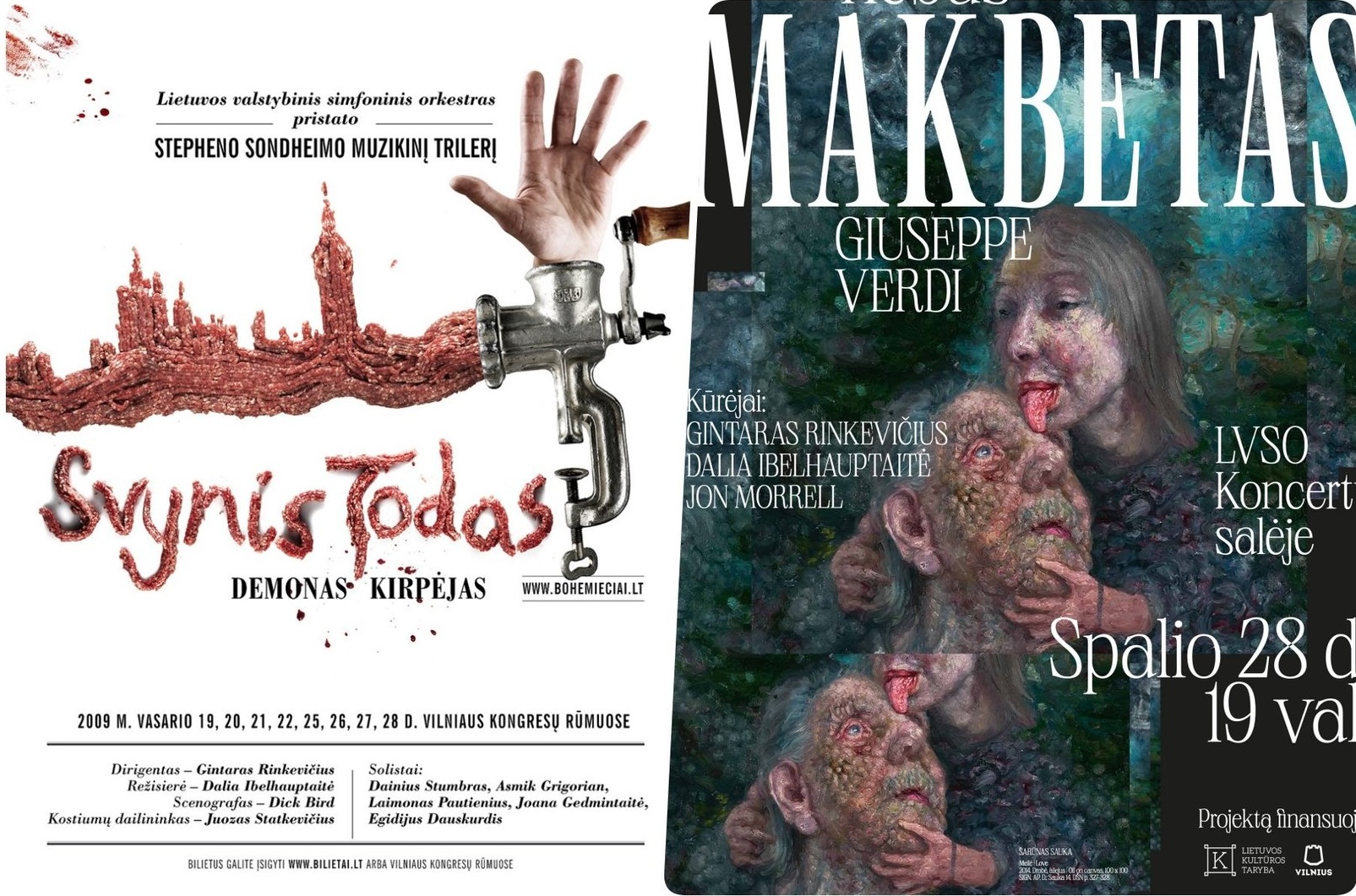
In preparation for the 2009 premiere of Stephen Sondheim’s musical Sweeney Todd: The Demon Barber of Fleet Street, its story about a murderous barber and the meat pies made from his victims became the basis of the entire advertising campaign. Minced meat and blood motifs appeared in the advertising, while director Kęstutis Drazdauskas created a promotional video resembling a short horror film. The Lithuanian Energy Museum was transformed into a human-meat-pie factory for the filming.
Advertising columns by JCDecaux appeared around the city, featuring a rotating meat grinder and paint resembling blood. According to Ibelhauptaitė, an advertisement featuring a meat grinder on a round column near the Congress Palace was banned. In February 2009, experts from the Office of the Inspector of Journalist Ethics assessed the advertisement as frightening and horrifying to minors. In April, the Lithuanian Radio and Television Commission fined LRT director general Audrius Siaurusevičius 2,000 litas for broadcasting a clip allegedly containing violent imagery.
The meat pies eaten in the performance were baked by the restaurant Bohème. On stage, they represented human-meat pies, while, according to Ibelhauptaitė, the campaign was supplemented by fabricated stories appearing in the press about the smell of human flesh supposedly coming from the restaurant. In this way, the musical’s dark humor spread beyond the walls of the theatre.
The campaign for the concert The Nightingales Return, created by Ogilvy Vilnius, was based on a different idea: everyone was supposed to notice the unexpected return of the birds in late autumn.
On November 11, 2010, Edmundas Jakilaitis was hosting the Lietuva tiesiogiai programme on Lietuvos rytas television. During the broadcast, what appeared to be nightingale droppings landed on the presenter’s shoulder. “The nightingales are back,” he said, and continued with the programme. A fragment of the broadcast spread online, and commentators speculated about what had happened in the studio. The following day, 15min wrote about the incident.
K. Taukačikas recalls that Jakilaitis himself agreed to the idea proposed by Ogilvy Vilnius and later became the host of the The Nightingales Return concert. With publisher Tomas Balžekas’s approval, the marks left by the birds also appeared in the printed pages of 15min at the time - without explanation, directly on articles, among photographs and headlines.
On December 7, a huge nest appeared beside the Congress Palace, built by the Bohemians’ long-time public relations agency, Bosanova. Inside it, singers and the director gathered to present the project The Nightingales Return. The nest reflected the concept of the programme: Lithuanian singers scattered across foreign theatres were returning to perform together.
“We are happy that we have somewhere to return to in Lithuania, to share our most unexpected dreams, carry out our boldest experiments, and make music together,” Ibelhauptaitė said at the time.
On October 14, 2011, the Lrytas.lt news portal joined another Bohemian provocation. A staged video of editor-in-chief Rimvydas Valatka being kidnapped began circulating on the site. The scene, filmed in an underground car park, was presented as an incident accidentally captured on a witness’s mobile phone. It soon became clear what was behind the idea: on that day, Ibelhauptaitė took over the editing of the portal, determined to devote more attention to opera and culture.
The provocation also attracted the attention of the police - two police crews arrived at the editorial office. Ibelhauptaitė recalls that she herself almost ended up being detained. The stunt sparked a public debate about how far advertising provocation can go.
The plots of the operas themselves inspired the advertising campaigns for many Bohemian productions. The love and duel story of Eugene Onegin, for example, was evoked by a metal heart that travelled around the city and by a presentation at a shooting range, where real gunshots rang out. Ibelhauptaitė’s decision to relocate the opera’s action to a Soviet communal apartment also introduced another theme: food.
In 2012, in preparation for the return of Eugene Onegin, Jamie Oliver, Beata Nicholson, Liutauras Čeprackas, and Deivydas Praspaliauskas offered recipes for Madame Larina’s ball. Their recipes were published weekly in Lietuvos rytas. Thus, people could learn about the opera while reading the food section and recreate the dishes served to its characters at their own festive tables.
That same year, when Ad Fingers created the advertising campaign for Manon Lescaut, it focused on the question of the value of emotions. News spread online about the supposed opening of a Family Lobotomy Clinic offering to rid people of unwanted emotions. As the creators explained at the time, the idea was inspired by the fates of the opera’s characters. Manon’s story of love, passion, and the temptations of the material world became a question: what would we lose along with our ability to feel pain?
K. Taukačikas also recalls a campaign by the advertising agency Not Perfect Vilnius, led by Paulius Senūta, for Ruggero Leoncavallo’s opera Pagliacci. Police officers with dogs burst into the performance and staged its interruption. The idea played with the boundary between theatre and a real event.
Opera singers could also be encountered on the way to the shops. In March 2013, a bathtub appeared in the window of the Omnitel shop on Gedimino Avenue, with Rafailas Karpis and Tadas Girininkas playing chess inside it. This was how the Arias from the Shower concerts were promoted. The campaign also invited passers-by to peek through holes cut into the shower curtain, behind which they could see an image of Asmik Grigorian singing in the shower. The advertising drew on the familiar habit of singing in the shower and aroused the curiosity of passers-by. A year later, VCO presented its new season with a performance by its singers in the Akropolis Maxima supermarket.
The creative agencies’ ideas were accompanied by Ibelhauptaitė’s willingness to try unusual proposals. Stefanija Jokštytė, VCO’s head of communications, creative professional, and founder of Menų komunikacija, experienced this during her first conversation about the electronic opera e-Carmen. At the time, while working at Not Perfect, she had proposed a provocative image of a woman with a vibrator for the electronic interpretation of the opera. Dalia liked the idea, but the campaign ultimately used a portrait of a female robot. Among other things, profiles were created for the characters of e-Carmen on the Tinder dating platform, while advertisements appeared on classified websites offering to exchange valuable possessions for e-Carmen tickets.
“There was room here for creative courage, humor, and an idea that might initially make you raise an eyebrow,” Jokštytė says.
Her collaboration with VCO eventually became one of her regular projects. Stefanija wanted a poster, video clip, or campaign to allow audiences to feel the energy of a performance before they even entered the auditorium. In 2017, at her suggestion, VCO’s eleventh season was presented at Vilnius Airport. Young singers disguised as airport employees and passengers began singing among the travelling crowds.
“I wanted to create exactly that kind of surprise - that opera would catch people off guard and enchant them before they had time to think about whether this art was for them,” says Jokštytė, the author of the airport campaign.
The location also had personal significance for the theatre’s people: performers travelling between stages around the world would return to Lithuania through the airport. Stefanija’s idea was carried out by the VCO team and its singers.
Meeting audiences also required some straightforward physical work. At the Book Fair, Dalia and Stefanija themselves carried mannequins dressed in performance costumes. At the Kaziukas Fair, they approached passers-by.
“At the Kaziukas Fair, we offered opera among wooden spoons and sausages,” Jokštytė recalls. She deliberately chose a location near the National Drama Theatre and the Vaga bookstore, where ticket offices operated: anyone who became interested only had to take a few steps and buy a ticket.
According to Ibelhauptaitė, the Bohemians were the first to present opera at the Vilnius Book Fair, which they later attended every year. At the Kaziukas Fair, among craftsmen and food vendors, they encountered a different audience. According to the director, 400 opera tickets were sold that time - the unexpected meeting place had proved successful.
Stefanija also wanted opera advertising to find a place in the homes of audiences. She suggested creating posters together with artists. This resulted in a Samson et Dalila poster with Andrius Zakarauskas, a Queen of Spades poster with Stasys Eidrigevičius, and two versions of Eugene Onegin with Ray Bartkus. For the image for Macbeth, designer Tadas Karpavičius used fragments of Šarūnas Sauka’s painting Love.
“I wanted to create posters that people would want to take home, frame, and keep,” Jokštytė says.
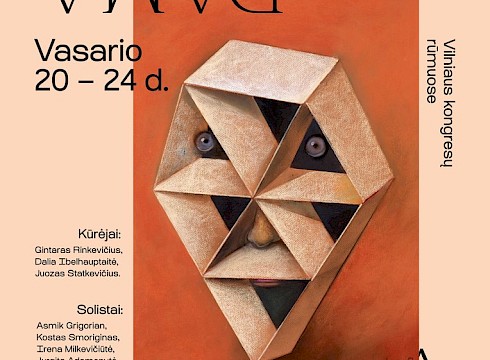
She carried out a similar idea with Tadas Karpavičius when creating the programme for Faust. Its cover reflected the viewer’s face. This solution drew the reader directly into the opera’s reflections on desires, choices, and their price.
“A person picks up the programme, and suddenly they themselves are inside the work,” Jokštytė says.
In 2020, while preparing the MO Museum and VCO exhibition From That Opera, Stefanija suggested turning the pedestrian crossing next to the museum into a piano keyboard. The exhibition’s motif greeted people in the street - those who never entered the museum also walked across it every day.
This autumn, to mark its twentieth anniversary, the Bohemians once again invited audiences to meet in the city. For four evenings, free screenings of recorded performances and engaging discussions took place in Vilnius Town Hall Square. For the anniversary, the logo created by Indrė Klimaitė of KLIMAITE KLIMAITE featured the number 20 formed from red adhesive tape. For Stefanija, this material evokes the everyday reality of a travelling theatre without a home of its own.
S. Jokštytė associates the anniversary slogan “Forever Young” with a creative attitude that she describes as “the ability, after twenty years, to still have the hunger to take risks and become excited about a new idea.” On the occasion of the anniversary, K. Taukačikas described the attraction of this community in his own way: “Careful, the organization everyone knows has the characteristics of a cult!” One of his memories illustrates how easily working with the Bohemians could turn into taking part in a performance.
During the theatrical concert Bohemians’ Dreams, sponsors and friends of the theatre were invited to play café patrons on stage. Some brought ham, others wine or cheese. Some sponsors, such as businessman Arvydas Avulis, even had to take part in a dance. This is just one of many examples of how the Bohemians created opportunities to make celebrations for themselves and others. People who contributed to the theatre could propose their own ideas, bring them to life, and participate themselves in what they had helped create.
K. Taukačikas concludes that the Bohemians’ advertising campaigns helped change perceptions of opera as a boring and pretentious art form, brought many young people to the theatre, and over twenty years of activity nurtured a new generation of opera enthusiasts who travelled from all over Lithuania to attend Bohemian performances.
Related news
Bohemians Turn 20: Anniversary Season to Culminate in Norma with Asmik Grigorian

Sustainability in opera: how Juozas Statkevičius’s costumes were given new life a decade later
When everything hangs in the balance on stage: the invisible heroines of Dalia Ibelhauptaitė’s productions reveal the secrets behind the scenes
Dalia Ibelhauptaitė: if I don’t fit into the clothes, there are always beautiful shoes!