Set designer Dick Bird: “we were not good children because we always went against the grain”
Deimantė Bulbenkaitė
“What wouldn’t you do for opera, right?” Set designer Dick Bird laughs from his London studio, speaking through his computer screen. Having created fantastical worlds on some of the biggest stages in the world and explored the backstage corridors of both the Metropolitan Opera in New York and London’s Royal Albert Hall, Bird also played a significant role in the birth of Vilnius City Opera.
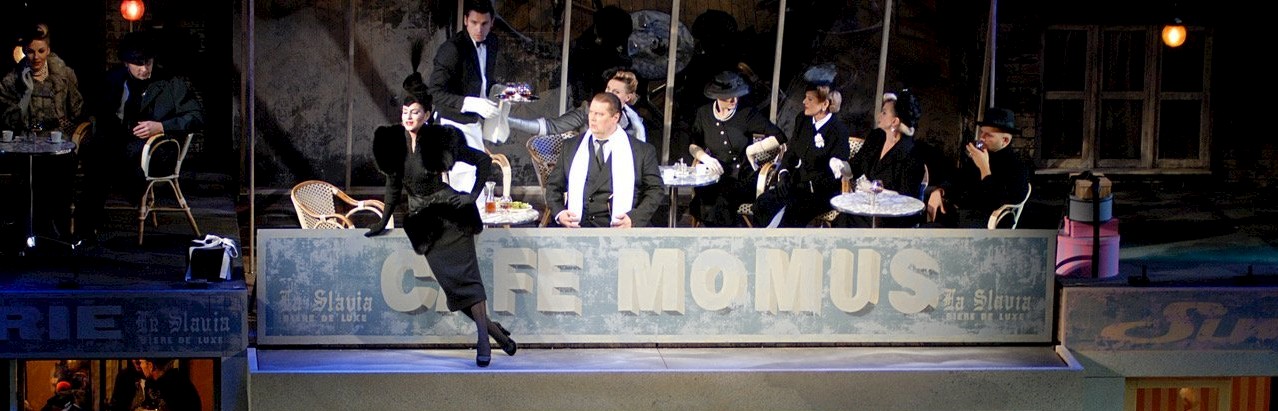
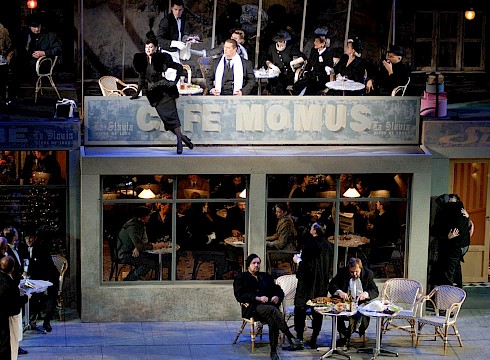
His contribution was so substantial that, in 2006, the Paris of Giacomo Puccini’s La Bohème, as imagined by Bird at Vilnius’s Congress Concert Hall, became the “Bohemians” company’s first home. The company’s name, derived from the opera’s title, still resonates in conversations around Vilnius today.
What have these two decades of working with Vilnius City Opera been like? What makes the institution distinctive in the context of Bird’s diverse international career? And, ultimately, how do you create a set when, right up until the last minute, so much seems simply impossible? A conversation with Bird takes us through the history of Vilnius City Opera, its most striking productions and the design solutions that brought them to life.
- Let’s start with how you first met Dalia Ibelhauptaitė. As I understand it, your first phone conversation about the upcoming production in Vilnius took place under rather unusual circumstances: you were stuck in London traffic, while Dalia was waiting for you at your studio. How do you remember that call?
- Dalia and I had worked together before. We staged Prokofiev’s The Gambler in Maastricht. My agent passed on something she had said at the time: the relationship between a director and a set designer is like a marriage - you have to fall in love first. I thought that was a lovely idea. The truth is, we didn’t fall in love immediately, but over the years, we certainly did.
For La Bohème, we were supposed to meet at my studio in South London, but I was driving from the other side of the city and got stuck in completely stationary traffic. Dalia was waiting at the studio, so in the end we had a very long conversation over the phone. She explained why she wanted to relocate La Bohème to 1950s Paris and why she was so drawn to the idea of time having been, in a sense, stolen from Lithuanians - the story of her parents, their deportation to Siberia, and the decades that had been lost. I found that deeply moving. It wasn’t about nostalgia, but about trying to recover a time people here had never been able to experience.
- Soon afterwards, you saw the Congress Concert Hall for the first time - almost the opposite of an opera house. What was your first impression?
- No fly tower, no wings, everything bright and exposed, nowhere to hide anything, no orchestra pit. My first thought was that it was a very difficult space, but… I like difficult spaces. In a conventional theatre, you take the proscenium, the curtain and the red velvet as given and don’t think too much about them. At the Congress Concert Hall, you simply cannot ignore the space itself.
Since there was nowhere to hide or lower the scenery, everything had to be built into the set design. I made a model and came up with that crazy roof, with a studio on top that could open up. I wasn’t sure whether it was a ridiculous idea. I showed it to Dalia. She makes a particular little sound when she gets really excited about something - a kind of squeak. She made that sound, and I knew: all right, this is the direction we’re going in.
The wonderful thing about working with Dalia is that you bring her something extravagant, and she pushes you even further. She’s a maximalist. I’m a bit of a maximalist myself, so I don’t need much encouragement.
- Dalia wanted to set La Bohème in 1950s Paris and introduced that period to you through a very specific context in Lithuanian history - as a time that had, in a sense, been taken away from Lithuanians. How did this idea change your perspective on the 1950s, and what did you immediately begin imagining as you worked on the set?
- If someone in Britain said, “Let’s set La Bohème in the 1950s,” you would probably think first of shiny American cars, progress and post-war optimism. Dalia spoke about that period in a completely different way.
Paris itself was still recovering from the war at the time. I was interested not in a gleaming, already modern city, but in a Paris just beginning to open up - as though little patches of light were gradually appearing in the darkness. I studied Eugène Atget’s photographs: old, dark streets, shadows, small pockets of light. As a result, the set even acquired something of a nineteenth-century atmosphere, with signs of a new era - shop signs and electric lighting - introduced into the older urban fabric. Then Juozas Statkevičius’s costumes added another distinct layer, clearly evoking the 1950s.
It was important to me that this should not be a decorative version of the fifties. In La Bohème, we are talking about poor young people who long to build a new life, while the city itself is only just beginning to reveal its possibilities to them.
- Colleagues remember the early years of “Bohemians” as rather chaotic. What stands out most to you from that period and those first productions?
- Oh, there are so many memories, and even more chaos. In the end, everything works out, but at the beginning, you don’t know that it will. [Laughs.]
The Magic Flute required a great deal of gold foil. In Britain, we use an inexpensive imitation for set design, but in Vilnius the only option available was genuine gold leaf, because it was used to decorate churches - and it cost perhaps ten times as much.
I also remember the women painting the scenery. Instead of a compressor, they had a cylindrical vacuum cleaner with a hose attached to the other end, so that it blew paint rather than sucked it in. Incredibly ingenious, although it made the work much harder.
The first time I visited the scenery workshops outside Vilnius, I felt as though I had arrived in the middle of nowhere: a huge old shed, freezing cold, an outdoor toilet that was just a hole in the ground, and men inside wearing thick layers of clothing while welding structures. It felt as though we were all testing one another’s bluff: could we really make what we had imagined?
We did a lot of the prop-making and painting ourselves. I brought my assistant, James Cotterill, and my wife, who is a painter, came over too. We spread plastic sheeting across the Congress Concert Hall foyer and set up a sort of workshop. But everyone worked with extraordinary passion. And then you saw those young singers - Edgaras Montvidas, Asmik Grigorian and the others - and there were no more questions. It was the first La Bohème I had seen in which the central characters genuinely looked like young people just beginning their journey through life.
- You have worked in many of the world’s major opera houses. What made “Bohemians” different on the international stage - and what has allowed it to remain so?
- The people. Of course, people work with passion in theatres all over the world, but in Vilnius we had to make everything happen despite a host of obstacles - in an unconventional space, with limited resources and a very small administrative team. We practically had to nurture an entire generation of specialists: stage managers, production managers and scenery builders. It was wonderful to watch their confidence and capabilities grow. Romas and his team were cautious at first, but after a few projects, it was clear that they could do anything.
The same was true of the singers. They would go out to the world’s great stages and then return to Lithuania with new experience. We felt a strong need to create something here. It may sound pompous, but we felt that what we were doing mattered to the country.
- When staging Eugene Onegin, Dalia Ibelhauptaitė suggested relocating the action to Soviet communal apartments - a setting you had never experienced yourself, but one the audience remembered very well. How can a foreigner get close to such a historical experience?
- You research, research, research. You look at countless photographs, but that only gives you a superficial, visual understanding. One of the most interesting aspects of being a set designer is that you constantly find yourself in different periods and have to immerse yourself in worlds you know almost nothing about.
Dalia knew that world, so I knew she would stop me if I made some terrible mistake. I had spent time in Berlin shortly after the Wall came down, visited Hungary and Poland, and been to Dalia’s parents’ apartment. But I had never been inside a genuine communal apartment.
A book of photographs of Havana proved very useful. It showed beautiful old buildings that had been subdivided into small living spaces. It was a completely different story, but it helped me understand what happens when elegant architecture is repurposed to house as many people as possible. That was our starting point for Onegin, too: a beautiful old house that could have belonged in a traditional nineteenth-century production, which we then seemed to dismantle from within using partitions and new structures.
- Faust became one of your favourite productions in Vilnius. What else did you discover when you set the story in the Congress Concert Hall?
- When I returned a few years later, I already knew what could be done in that space. You can then stop asking, “Is this possible?” and start asking, “How else could we transform it?” I remember showing the model to Dalia and Jon Morrell in a café in central Vilnius. I was demonstrating how one scene transitioned into the next, and for a while they couldn’t work out what was moving where. To me, that was a wonderful sign!
Scale was extremely important here. Set design works not only intellectually but physically, too. A small space can create claustrophobia; a vast one can evoke a sense of freedom. At the beginning of Faust, the protagonist is almost imprisoned at the end of his life and his possibilities. Outside the window, he hears young people singing, full of optimism, and then his world suddenly bursts open. The most interesting thing is when you don’t need to explain such emotions - the audience feels them through the space itself.
- How much freedom did you have when working with Dalia and the long-standing team?
- A great deal. I have enormous respect for Peter Mumford and Jon Morrell, and every time I work with them, I feel privileged. They could continue their careers anywhere in the world, but they kept returning to this crazy space, not for the biggest fees, but because we enjoyed being together and working with Dalia.
Of course, she keeps a very firm grip on everything, but at the same time she gives you tremendous creative freedom. She knows how to recognise a person’s strengths and then allows and encourages them to develop.
- When did you realise that “Bohemians” had become an institution in its own right, with a distinctive identity?
- Probably quite late. All those years, we would look across the street at the Opera and Ballet Theatre - a large building with chandeliers in the foyer. I wouldn’t say they were our enemies, but they were a respectable cultural institution, while we were rebels, troublemakers, the bad kids.
Many years later, when I went there to work on Don Giovanni, I discovered that a great many people in the theatre had started their careers with “Bohemians”. That’s when you realise that things really have changed.
But I always liked that punk spirit. We weren’t obedient, perfect children who quietly did their homework. We went against the grain.
- Do you have a favourite story that best captures the spirit of “Bohemians”?
- I’m not sure I should tell this one. Perhaps I ought to show it to Dalia first. [Laughs.] I tend to give people feedback very gently. Once, I was trying to explain to a prop maker that the chair he had made wasn’t quite what I had expected. I put my computer on it, showed him a photograph and explained everything very politely…
Then Dalia walked in, looked at the chair, and I had to snatch my computer off it very quickly. Let’s just say that her way of expressing dissatisfaction with the chair was much more direct than mine.
After the first performance, Romas also started filming my model presentations so that I couldn’t discreetly add new things after he had already calculated the costs. [Laughs.]
- To close our conversation: what does being one of the “Bohemians” mean to you personally?
- I suppose I’ll end up saying the word “family” after all. There is a genuine bond, a sense of kinship, something that comes close to love.
We truly cared about what we were creating together. We did it under difficult circumstances, without a lot of money, because we loved doing it and felt that it mattered. I think we simply fell in love with the creative process we shared.
Related news
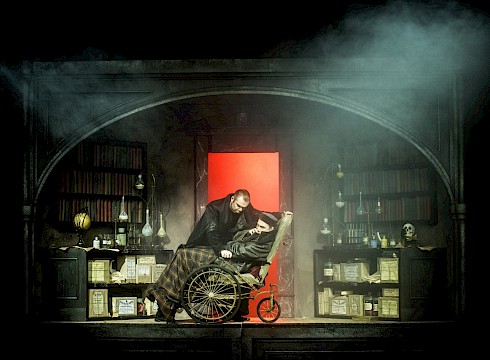
Bohemians Turn 20: Anniversary Season to Culminate in Norma with Asmik Grigorian
Sustainability in opera: how Juozas Statkevičius’s costumes were given new life a decade later
When everything hangs in the balance on stage: the invisible heroines of Dalia Ibelhauptaitė’s productions reveal the secrets behind the scenes
How Bohemians’ advertising took to the streets and changed perceptions of opera