The first and only “Sweeney Todd – The Demon Barber” – on the Town Hall Square screen
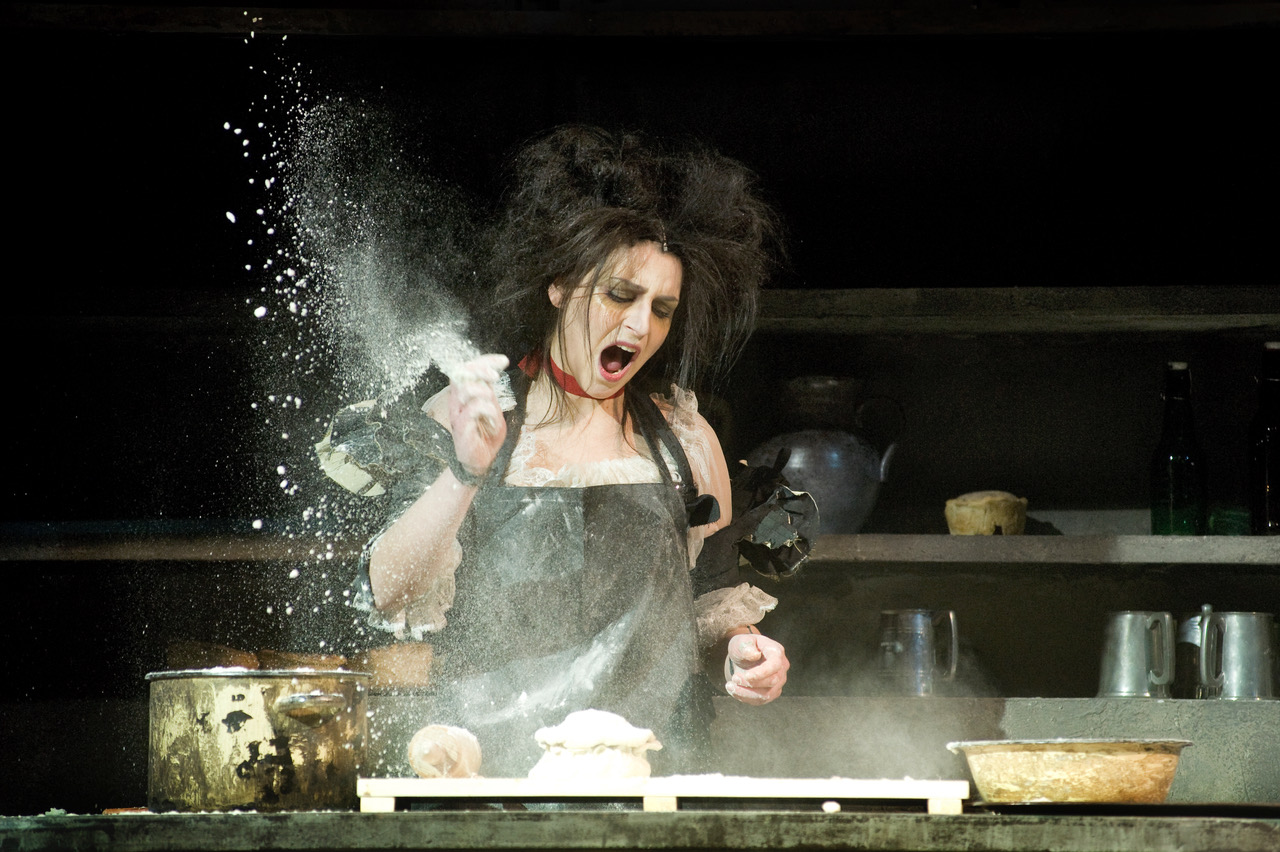
The renowned Stephen Sondheim musical “Sweeney Todd – The Demon Barber”, staged in Lithuania by Vilnius City Opera, became something exceptional not only for the troupe, but also for audiences.
The show’s music,new in the repertoire of the “Bohemians” and the Lithuanian State Symphony Orchestra led by maestro Gintaras Rinkevičius, the exceptionally demanding stage performance and the original costumes were all remarkable, and brought a huge number of young people into the world of opera, not only on stage but also in the audience. This year, everyone who wishes to encounter or re-visit one of the biggest hits in the VCO repertoire will be able to do so in Vilnius Town Hall Square.
It will be shown on the screen on September 19 at 7 p.m.
Looking back at the 2009 premiere, the story of how the opera’s soloists mastered the musical theatre genre sounds almost unbelievable even today: studying through the nights, perfecting English pronunciation, endless rehearsals, counting every action on stage down to the exact second... Unlike in traditional opera, an aria in a musical demands three times more intense action; there are no moments when one can comfortably stand and simply sing the notes. Everything has to happen simultaneously and quickly, and with the highest level of acting professionalism.
Dainius Stumbras and Asmik Grigorian studied their parts for as long as five months. Asmik’s lips even became swollen from practising English tongue twisters – after all, she did not speak English at all before beginning the work. In the finale, the soloist sang perfectly even with a typical Cockney accent.
That year, Asmik Grigorian was deservedly awarded Lithuania’s highest stage honour – the Golden Stage Cross – for her role as Mrs Lovett.
Director Dalia Ibelhauptaitė was delighted at the time that the two months of the most intensive rehearsals in the history of the “Bohemians” had paid off – she was convinced that even ten years later, if the soloists were woken up in the middle of the night, they would not only sing the aria from memory, but would also perform all the rehearsed actions.
It is interesting to wonder whether such a test ever actually took place. Memorable roles in “Sweeney Todd” were also created by Laimonas Pautienius, Joana Gedmintaitė, Egidijus Dauskurdis, Arūnas Malikėnas, Rafailas Karpis, Audrius Rubežius, Edmundas Seilius, and later Jeronimas Milius, Lauryna Bendžiūnaitė, Tadas Girininkas and others.
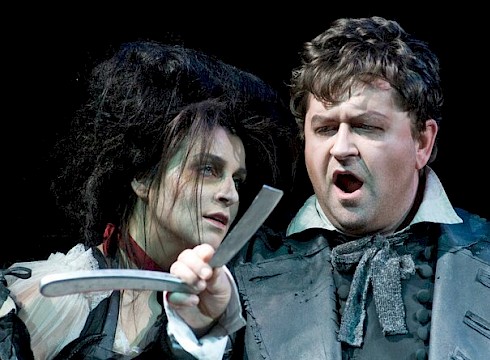
“Sweeney Todd” is considered one of the most demanding musicals, a tough nut to crack for performers. Its score could be described as an intricate spider’s web woven from melodies. S. Sondheim meticulously marked even the smallest actions of the characters: when the barber has to raise the razor, when to lower it, when Mrs Lovett kills a cockroach, etc.
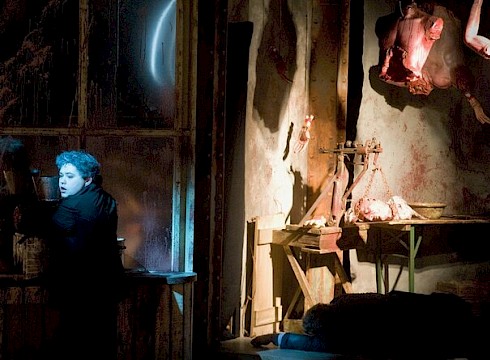
In the production of “Sweeney Todd”, scenographer Dick Bird surpassed himself by creating the most complex set ever seen on the then Congress Palace stage: with dozens of changes taking place precisely in time with the music, the control of which required the assistance of ten technicians and stage managers.
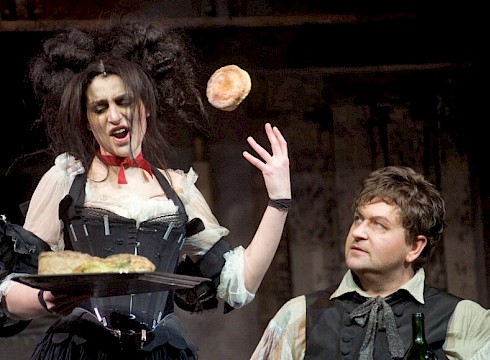
The freely flowing stage blood was ordered from Germany by the dozens of litres, while the real pies eaten on stage were baked according to a special recipe and historic British design by the “Bohème” restaurant. Everything was crowned by the dynamic lighting of master of light Peter Mumford.
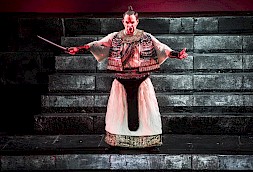
There was no shortage of detail in the costumes created by Juozas Statkevičius either. He himself cut the “moth-eaten holes” in the jackets and dyed the Beggar Woman character’s petticoats, supposedly soaked in urine, with tea... Throughout all the years since the premiere, the clothes not only returned to the stage with a bang each time, still looking magnificent, but were also exhibited in exhibitions. Every costume of a soloist and chorus performer is like an authentic nineteenth-century garment, recreated down to every pocket and button, while still leaving room for theatrical imagination.
Things were not easy for the Lithuanian State Symphony Orchestra under maestro Gintaras Rinkevičius either. The encounter with this genre of music theater and with Sondheim’s music was the first in the orchestra’s history.There is no doubt that the experience with S. Sondheim’s musical opened the door to further experiments. To prepare for the premiere, conductor James Holmes from Great Britain was invited, and provided invaluable musical and linguistic foundation and precision in the performance Another guest from Britain, Collin Pink, handled the sound engineering solutions.
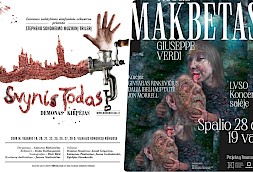
The 2009 premiere was accompanied by a striking advertising campaign, which also faced opposition and accusations of promoting violence. It was censored both on television and on outdoor billboards, resulting in several years of court proceedings. Yet it became clear at the time that it was precisely the younger generation that was best prepared to embrace not only theatrical innovations, but also themes relevant to the present day.
The large numbers of young people attending the production neither questioned nor recoiled from the violence and brutality depicted. They understood that it was just theatre, and focused on the central theme of the show: that no matter how deeply you have been hurt or what injustice in life weighs upon you, the path of revenge and hatred will never lead to the light... Moreover, it is the young, untouched-by-life lovers Joana and Anthony who are the two characters in the “Sweeney” story who survive– the future and the possibility of creating a different, new and brighter world belong to them.
Without attempting to change the period or make the details more contemporary, the “Bohemians” grasped the essence of theSweeney Todd– a performance demanding the highest possible quality, motivated by a sincere love of the work. The entire troupe worked according to this principle, transforming the LVSO Concert Hall into a Broadway stage on the evenings when “Sweeney Todd” was performed.
Related news
Bohemians Turn 20: Anniversary Season to Culminate in Norma with Asmik Grigorian

Sustainability in opera: how Juozas Statkevičius’s costumes were given new life a decade later
When everything hangs in the balance on stage: the invisible heroines of Dalia Ibelhauptaitė’s productions reveal the secrets behind the scenes
How Bohemians’ advertising took to the streets and changed perceptions of opera