Bloody fingers, 80 wigs and a month of coughing up gold: the invisible side of the Bohemians’ productions
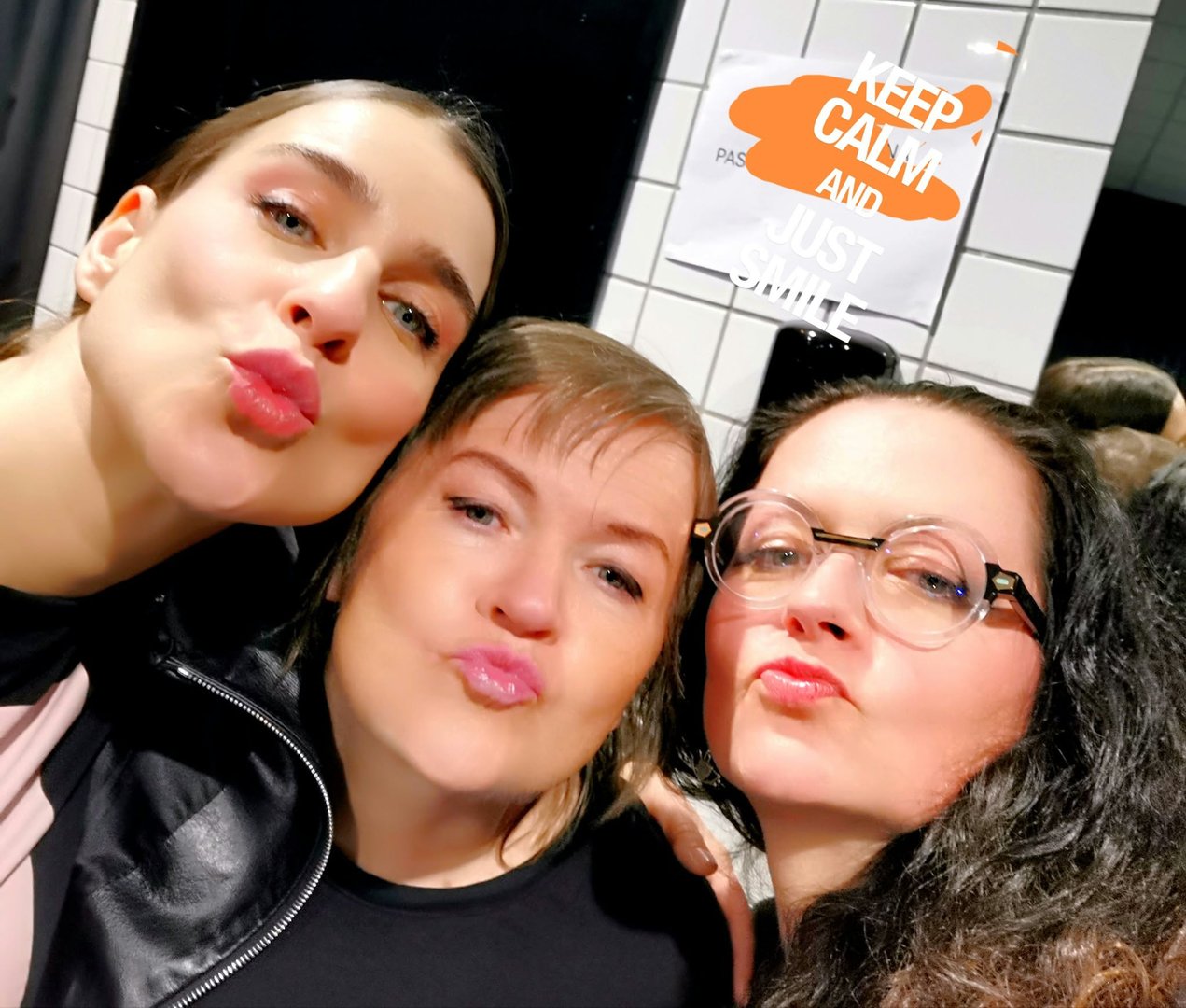
Every Bohemians performance begins not on stage, but in the makeup room. People arrive with their own worries and leave as flirtatious, demonic or comic characters.
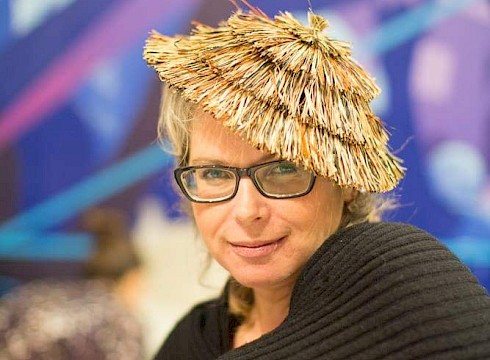
As the Bohemians celebrate their twentieth anniversary, we open the door to this room with two women whose hands have shaped the faces and hairstyles of the company: makeup artist Ūla Pakalniškytė and hairstylist Dalia Žakytė-Bučienė. Audiences never see their work itself - only the result. Everything that matters most happens before the curtain rises.
“I knew very well that I would never work in theatre”
Dalia Žakytė-Bučienė grew up in the theatre. “The theatre had been very familiar to me since childhood. My mother, Eugenija Žakytė, worked as the head costume supervisor, and I would spend my days at work with her. I knew very well that I would never work in theatre.”
Dalia believes it was her mother who arranged her first job: a makeup artist was urgently needed to travel on tour with a theatre company. “My task in my very first production was to stick a moustache onto an actor. Eventually, I fell in love with the profession. I immersed myself in it with great pleasure and even found myself looking forward to my days off passing quickly so I could hurry back to the theatre.”
There were no makeup schools at the time, so she learned the trade from more experienced colleagues. She handed pins to senior makeup artist Laimutė Merkelienė, while learning to make wigs and moustaches from an old master who had once worked alongside renowned makeup artists at the Kaunas Musical Theatre and the Opera and Ballet Theatre.
Ūla Pakalniškytė took a different path. She studied makeup design, completed an internship at the Lithuanian National Opera and Ballet Theatre, and found her true school in film. “Film was what really matured me professionally.”
La Bohème, where it all began
Both women were brought to the Bohemians by the same person: designer Juozas Statkevičius. In 2006, he invited Dalia to create hairstyles for the entire cast of La Bohème. “I remember working on La Bohème for the first time. There were more than 40 female performers alone, and I was on my own! My fingers were literally bloody from all the hairpins… I remember that experience with both horror and satisfaction.
“Of course, every first production is more difficult, especially when you’re working with a new company and don’t yet know the faces or the hair. You have to discover everything and work out how to achieve the look you want.”
Statkevičius also invited Ūla to join Vilnius City Opera. “Dalia Ibelhauptaitė’s approach to opera was so interesting and innovative. La Bohème was a wonderful discovery for me, as were the director’s later works. Historical imagery was combined with fragments of film, while the period costumes by Juozas Statkevičius and costume designer Jon Morrell shone on stage.” Today, she adds: “Well, it all began with La Bohème, and in every subsequent project and production, it was always remembered as the starting point and the model to follow.”
Dalia’s favourite era is the 1940s, and she has her own theory about why women of that time were so beautiful: so many men had died in the war that women had to dress up and strive to be more beautiful than one another to win the hearts of those who had survived. Ūla feels drawn to the same period. “My favourite historical era stretches from the beginning of the twentieth century right through to the 1950s. I think femininity blossomed most beautifully then. The woman of that era was a little seductive and aggressive, modest and bold. Her appearance reflected a perfect whole.”
One makeup box
Today, it is hard to believe that not so long ago, theatre makeup artists worked with almost nothing. Juozas Statkevičius’s ingenuity made an impression on Dalia from their very first collaborations. “Juozas would come in and say, ‘We need black eyeshadow.’ What black eyeshadow? Back then, we had just one makeup box, and all the makeup in it was cream-based - nothing loose or powdered!
“So we burned a wine cork, rubbed it down and used it to colour things. Later, some new kind of brush appeared, too… Juozas was already incredibly creative back then and brought so many new ideas into our work. I think working with him is every makeup artist’s dream.”
Ūla remembers the same shortages. “We used to have just one palette in the theatre, and we used it for every task.” According to her, makeup was applied with a clear purpose, but rather crudely, often using special cardboard sticks or fingers.
From sketch to opening night
How does a Bohemian character’s face come to life? Ūla describes the process step by step. “Before a premiere, I need to find out what the new production is about and get as much information as possible from the costume designer. Then I see the costume sketches and get a sense of the production’s colour palette.
“I decide whether we’ll use wigs or the performers’ natural hair. A week or two before the premiere, makeup tests begin. We check even the smallest details: the shape of the eyes and eyebrows, how the chosen makeup colours look on stage, and how the performers feel wearing the makeup. The director usually joins us at that point and gives their opinion.”
Dalia is most drawn to this exploratory stage. “I really enjoy the process of searching and creating, meeting with the designer, discussing things and thinking about how to bring their vision to life. How can we make it look beautiful while ensuring it stays securely in place and can be done fairly quickly? “I have a little doll with hair that I use to test everything. Of course, nothing works out on the first try, and even when it does, you keep refining it, searching and trying something new every time.”
What do makeup artists dislike most? “Cleaning brushes,” Ūla laughs. “When you’re doing creative work, you use every tool within reach. So, while a production is being prepared - before the idea has been fully refined and the structure of the work has taken shape - our tables look as if there’s been an explosion.”
Once the production premieres, the finished look is no longer changed. “In fact, after the final version is established at the premiere, nothing changes; it is preserved,” Dalia explains. So when an actor asks her to apply a little less makeup today, she replies: “No, I can’t - act less!”
From far away, boldly and quickly
Stage makeup is not designed for the person sitting closest to the stage. “When applying makeup, you always keep in mind that the first audience member will be sitting far away,” Ūla explains. “The ability to see an actor’s face from a distance while you’re working comes with experience.” She compares theatre with film, where she has also worked. “In film, makeup is a hundred times subtler; everything is extremely meticulous. In theatre, the strokes are broad and the colours vivid. But to choose those colours logically, you need to understand colour psychology and the directions of lines and their emotional significance.”
According to Dalia, opera calls for even bolder choices than drama. “In opera, makeup and hairstyles create more striking characters. I think that’s partly due to the nature of the art form: some of a soloist’s acting is ‘swallowed up’ by the demands of complex singing, and distance is another factor. In a drama theatre - especially one like the Small Theatre - the audience is very close, so you can’t overdo the makeup. Opera houses have larger auditoriums, and, first of all, the orchestra separates the performers from the audience.”
The same principle applies to hairstyles. “Opera stands out because hairstyles need to be even more expressive. You have to focus on the overall shape, not the details. Even the person sitting furthest away must be able to see it.”
And everything has to be done quickly. “You have to create an actor’s hairstyle very quickly. Along with makeup, you get fifteen minutes, twenty at most. Although if I feel I’m being rushed, I ask people to stop, because otherwise the combs and hairpins start slipping out of my hands,” she laughs. “A good makeup artist works professionally, quickly and securely, making sure everything holds its shape - that it doesn’t fall out, come loose or unravel.”
A soloist in the makeup chair
According to Dalia, opera soloists are different from actors. “Opera soloists seem the most serious to me. They value their main instrument - their voice - enormously, and they really concentrate.” She begins working on every new character with a conversation. “When an actor is creating a new character, I always ask them, ‘Tell me about yourself.’
“That way, I hear the story of the character they’re creating, and we discuss what kind of personality they have. Finding common ground with the performer is very important.” The makeup room becomes something more, too. “It’s like a confessional: people come in with their problems, and you try to listen and offer advice. The actors know that nothing they say here will get out.”
For Ūla, the room is a place of transformation. “I realised that makeup can completely change a person. An actor comes into the makeup room with all kinds of problems, setbacks and worries about their children, then leaves transformed, having left everyday life behind and immersed themselves in the role - an entirely different person.” Looking back, she says that one of her greatest pleasures was working with the Bohemian soloists, “who would turn into characters at your touch: some flirtatious, some demonic, others strange and comical.”
That is why she tries to make the makeup room an island of calm. “The makeup room is a place for concentration, but also a haven for relaxation and rest before demanding, emotionally challenging work. I always try to ensure that when actors leave this space for the stage, they feel calm and at peace, with a sense of harmony.”
The grey cardinals
The position of backstage workers in the theatre has not always been what it is today. “In any case, attitudes towards people who work behind the scenes - what I call the ‘grey cardinals’ - have changed. In Soviet times, when independence was still nowhere in sight, there were these grand ladies, known as minister’s wives, who took all kinds of liberties…
“And we were the poor little people who helped actors get ready, and we were treated like servants. We were never invited to premiere celebrations. Today, we’re always welcome,” Dalia recalls.
Both women felt they were treated as equals within the Bohemians’ team. “When it comes to opera, both Dalia Ibelhauptaitė and Juozas Statkevičius are outstanding professionals. They know exactly how everything should be done and place great value on makeup. They care about how every single person in a production looks, even if that person appears on stage for just two minutes and stands somewhere in the distance.
“People like that make you want to push yourself and strive for the best possible result,” says Dalia Žakytė-Bučienė. “Working with people like them makes you feel needed, valued and loved - an equal part of the creative process, part of a family working towards the same goal.”
Ūla emphasises the same commitment to quality. “Working with director Dalia Ibelhauptaitė is a pleasure because I know she will never lower her standards, whether it’s opening night or the tenth performance. Normally, a team puts in its greatest effort for perhaps the first four performances.”
Today, she adds: “When you work with Dalia, you always know that your creative potential will be fully used. You know you’re a full-fledged member of the team and can suggest ways to improve or simplify the soloists’ looks. It’s the kind of work you always wanted to go to - because of the people, the good atmosphere, the mutual understanding and respect. There were so many interesting challenges that pushed me to grow.”
Forever young
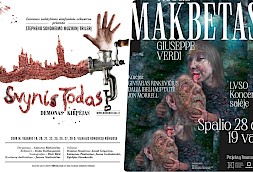
Asked to name her favourite Bohemian productions, Ūla comes up with a whole list. “We had a wonderful Faust - challenging but spectacular - The Magic Flute, where we coughed up gold glitter, Eugene Onegin, which smelled of pancakes, an electronic Carmen and, of course, Sweeney Todd. I wouldn’t want to single out just one, because we lived and created together in all of them, with boundless enthusiasm.”
The premiere remains a special moment for both women. “I think that if a makeup artist no longer feels nervous before a premiere, they may have professionally run out of steam. Nervousness is a good incentive to improve,” Ūla says. Dalia compares premieres to childbirth. “I prepare for and look forward to premieres so much - they’re like a baby coming into the world.”
She even has her own testing ground. “I have a little doll with hair that I use to test everything. Of course, nothing works out on the first try, and even when it does, you keep refining it, searching and trying something new every time.”
Gold dust
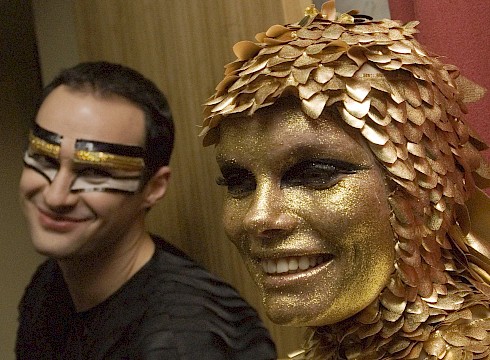
The Magic Flute undoubtedly presented the greatest challenges. Ūla remembers: “When Juozas brought in a cellophane bag and put it on the makeup table, I became curious. And this wasn’t some tiny little bag - it was filled with a couple of kilograms of fine, loose, flour-like golden glitter. The product was obvious, but what on earth did we need so much of it for? “We soon got our answer. To complement Juozas’s fantastic gold costumes, the soloists’ faces had to be completely covered in this golden dust.
“My first thought was: ‘Just imagine how it will sparkle!’ The second was a little more cautious: ‘How will the soloists react to all this?’ But the Bohemians are creative hooligans, and they agreed. No lengthy deliberations. After the performance, we all spent a good month coughing up gold together. “Working with Juozas was always a challenge of sorts - a test of how much creativity, ingenuity and courage we could bring to designing a look and making it happen.
“It wasn’t enough simply to ‘do the makeup’. We had to create an entire world together, a world where everything could be bigger, bolder and brighter. So when we started thinking about how to style the chorus, ideas poured out as if from a cornucopia.
“We covered faces with various shiny strips and gold, and decorated eyes and eyebrows. The result was amazing! We applied the same idea to the other soloists, too. In this production, the audience had to do more than see luxury overflowing - they almost had to smell it. For us makeup artists, it was another chance to discover that theatre begins when we allow ourselves not to be afraid of our imagination.”
For that production, Dalia had to prepare eighty wigs. “There were lots of black wigs, worn by both women and men. Every one of them had to be cut, styled and decorated with golden snakes. The men’s wigs were the hardest, because once we cut them, the hair would stick up and puff out. So we decided to secure all of them tightly with hairpins, which took a great deal of time and effort.
“We used huge amounts of gold-coloured glitter to make the wigs sparkle. We sprayed them with hairspray and sprinkled on the glitter so it would stick. There was so much glitter that everyone involved in the production kept sparkling for another week afterwards. Not just us, but our bed linen, too. Our outer clothes and even our underwear…” And the hardest day she had with the Bohemians? Ūla answers in a single sentence: “When we stopped performing the productions…”
“The Bohemians,” she says, “were a family that encouraged and nurtured one another’s talent and originality.” Perhaps that is why their twentieth anniversary is called Forever Young: in the makeup room, every premiere is still awaited as if it were the first.
The text quotes interviews with Ūla Pakalniškytė and Dalia Žakytė-Bučienė by Monika Visockytė, published in L’Officiel Mada magazine; an interview with Dalia Žakytė-Bučienė from the Vilnius City Opera archive; and new responses from Ūla Pakalniškytė.
Related news
Bohemians Turn 20: Anniversary Season to Culminate in Norma with Asmik Grigorian
Sustainability in opera: how Juozas Statkevičius’s costumes were given new life a decade later
When everything hangs in the balance on stage: the invisible heroines of Dalia Ibelhauptaitė’s productions reveal the secrets behind the scenes
How Bohemians’ advertising took to the streets and changed perceptions of opera