Life is a very simple but certainly not an easy thing (2nd part)
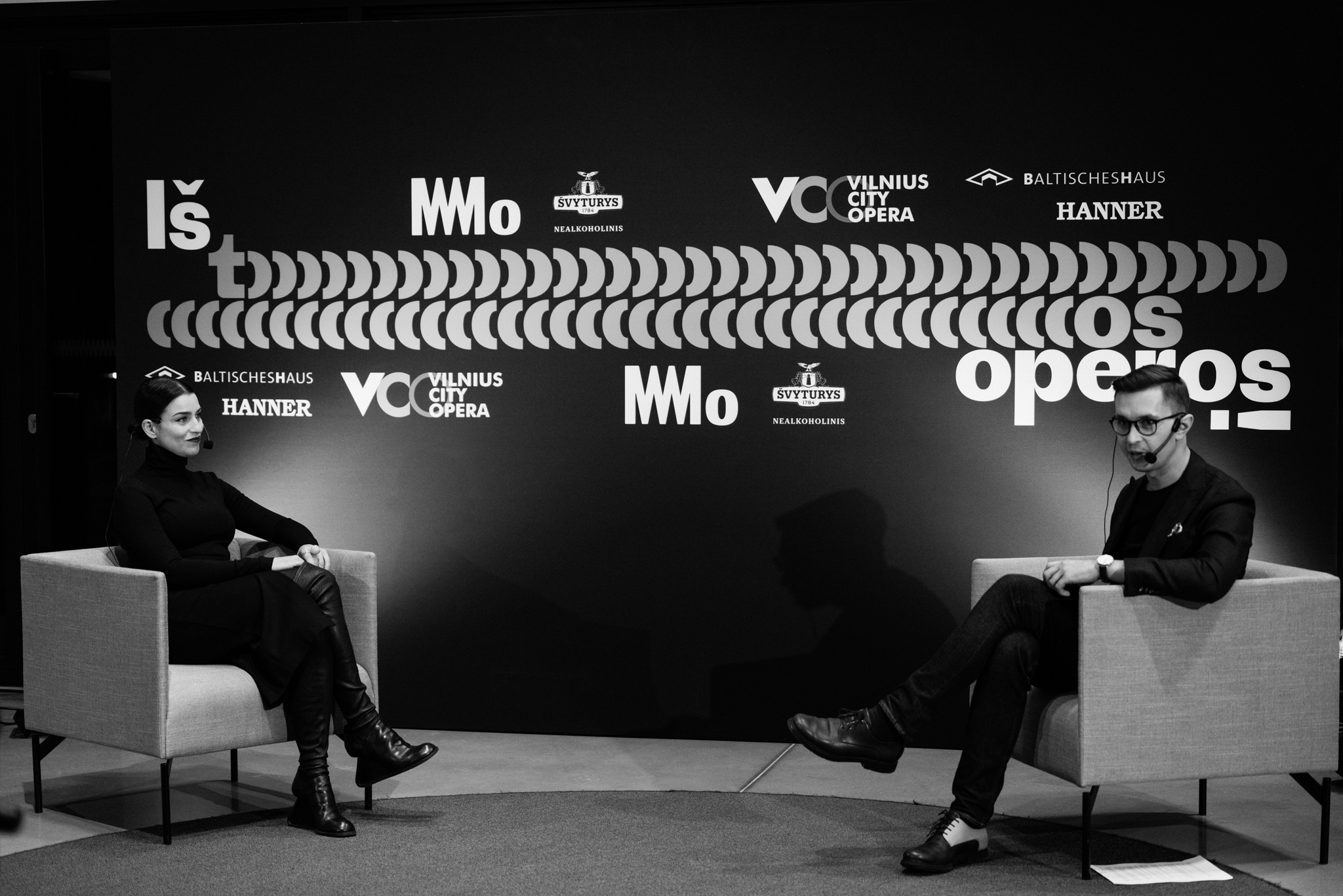
Julijus Grickevičius talks with Asmik Grigorian
Trying to introduce Asmik again is probably pointless. It would be more accurate to say that, for the first time in a very long while, the opera soloist sat down for a thorough conversation covering almost her entire career, encompassing much more than any biographical paragraph ever could.
Julijus Grickevičius: I read your 2015 interview with Dalia, and I’ve never seen a warmer, more open conversation where two kindred spirits spoke so freely. I thought I’d try asking some of Dalia’s questions. Answer as you feel now. We’ll need to go back to your youth.
Asmik Grigorian: You can’t go back to youth - hasn’t anyone told you that? (laughs)
Julijus Grickevičius: That’s also an interesting question: how do you perceive yourself in time? Sometimes you look at yourself 10 years ago and it feels like that was another “me,” not you…
Asmik Grigorian: Even looking at yesterday, I could say the same. Every day is completely different, and I tend to push my limits. My pace is so fast that even looking a week back, I could say I’m not the same person (laughs).
Julijus Grickevičius: Dalia asks: “You never fit into any framework, especially in Lithuania. Every maverick is scrutinized under a magnifying glass. Do you think that helps you achieve more or crushes you?”
Asmik Grigorian: I think both. In some ways it helps, but I tend to think it mostly crushes.
Julijus Grickevičius: And then you said it crushes. Dalia asks: “So now count how many piercings you had in your youth?”
Asmik Grigorian: Thirteen.
Julijus Grickevičius: And Dalia said: “The thirteenth one you did yourself at home with a pin!”
Asmik Grigorian: Yes (smiles).
Julijus Grickevičius: And what about other extremes? In that interview, you spoke vaguely about drugs and alcohol. Were these experiments, testing boundaries?
Asmik Grigorian: If you’re an experimenting person, you inevitably encounter such things. I’ve tried a lot in life. I was fortunate to always have some intuition, a sense or knowledge of where I wanted or didn’t want to be.
Julijus Grickevičius: Dalia asks: “What is sin to you? Do you think it’s part of life’s path, its seasoning?”
Asmik Grigorian: I think the greatest sin in life is not using your potential, your opportunities, and what is given to you each day.
Julijus Grickevičius: First, you have to know what is given to you…
Asmik Grigorian: Everything is given - just to breathe, to move, to act. You just need to feel it.
Julijus Grickevičius: Let’s talk about your breaking point, the time when you were working intensely - performing not only in operas and Bohemians’ productions, but abroad… There must have been a limit, when a person who burns themselves eventually risks burning out. That was 2012, VCO’s “Manon Lescaut”?
Asmik Grigorian: Professionally, yes. It was a breaking point, a time when something had to change. As banal as it sounds, such things follow cycles, and at least for me, they tend to recur systematically about every seven years (laughs).
At that time, I had to decide: do I continue burning my energy at the same pace, which would leave little career time, or stop? For me, that meant undergoing vocal surgery. That moment makes you pause, reflect, and approach everything differently.
Julijus Grickevičius: Was there a chance you might stop singing and do something else?
Asmik Grigorian: That’s always a possibility. I live my life balancing as if I’ll live a long time, but in reality, I live day by day. So, when surgery came, and I faced the possibility that anything could happen, I thought I’d consider that only if it really occurred. Today I sing, so I focus on what I can do best. If a day comes when I can’t or don’t want to sing anymore, I’ll deal with it then. There are millions of paths. Always (smiles).
Julijus Grickevičius: You’ve joked about being a makeup artist?
Asmik Grigorian: Yes (laughs).
Julijus Grickevičius: And Dalia said you could be head of the makeup department if you wanted.
Asmik Grigorian: One theater director once said that if I ever decide to stop singing, he would want me as his assistant because he’s never seen someone who plans so well (laughs). So, there are always alternatives.
Julijus Grickevičius: But when you’re around 30, and you set a new reference point for yourself, that’s quite heroic.
Asmik Grigorian: I was lucky to face it at thirty because now it would be much harder.
Julijus Grickevičius: What would you do differently?
Asmik Grigorian: You have to choose your repertoire carefully, study diligently, and first of all, learn to sing. Learn technique.
Julijus Grickevičius: Which of your roles drain your voice, and which help restore and train it?
Asmik Grigorian: Technically, Italian repertoire is like medicine for me. Emotionally, all roles consume and exhaust, but they also give a lot of experience. I’ve lived many lives in one lifetime and grown as a person quickly. You can learn from each role. Later, life presents decisions that I have to make, and I already know where they can lead. This helps me as Asmik.
Julijus Grickevičius: You never studied acting professionally, right? This is a gift you were given. Who were the most important collaborators who helped you develop your acting?
Asmik Grigorian: Many. Every experience teaches something. I grew with directors, and on stage you discover your strengths and weaknesses. You learn how to express a thought through your body so people understand you. Vocal technique gives you choices - singing doesn’t always have to sound beautiful; it’s your palette. Acting is similar: stage technique allows you to communicate. Singing and acting are languages to speak to people.
Julijus Grickevičius: Many think your success came suddenly - Salome in Salzburg, global recognition - but you worked for years in theaters in Cologne and Graz, which aren’t La Scala. Was that an important stage of the journey?
Asmik Grigorian: Absolutely, it’s a process. Some jump straight onto big stages, but usually their journey is very short. You have to go through the path, learn, train. Like sports, you can’t lift 100 kg immediately. Everything happens step by step. Opportunities come, but the biggest factor for me is endless determination, persistence, and courage to use every given opportunity 100 percent.
Julijus Grickevičius: Let’s briefly go to Salzburg. Both in 2016 and 2018, Salzburg was a “fireworks” period in your career. Your name shone globally. Salzburg comes with great responsibility. How did you manage this pressure?
Asmik Grigorian: Of course, there was pressure. But I see it differently. Whether Cologne or Salzburg, I do everything to the best of my ability. When you give 100 percent, fear disappears. What’s left is self-confidence. People may like it or not - that’s beyond my control. I did everything I could, so I feel calm.
Also, gratitude to those who invited me to sing the role is far stronger than pressure. Love and trust for those who believe in me guide me more than fear or doubt.
Julijus Grickevičius: In 19th-century Puccini or Verdi operas, women tend to stumble into situations, sometimes accidentally (laughs). They are also fierce and sometimes domineering. In 20th-century opera, we enter a world of symbols and myths with unresolved questions. Perhaps that’s why Salome, which begins the 20th century, is so interesting. How do you experience Salome? How do you explain her motives?
Asmik Grigorian: All my roles are part of me. For example, Salome and Tatiana (“Eugene Onegin”) aren’t far apart for me. They are the same woman, a girl caught in circumstances. Just like me, Asmik, I could have been many things. Circumstances shaped me; today I am who I am. Salome made her decisions in her context; Tatiana would have acted differently in another. For me, it’s the same woman (smiles).
Julijus Grickevičius: You don’t feel the silent urge to justify the character?
Asmik Grigorian: It happens naturally. I think everyone wants to justify themselves in some way. I always try to justify my characters because that character is me (laughs).
Julijus Grickevičius: And the moment of death on stage?
Asmik Grigorian: I don’t know - I’ve died so many times… My strength is probably making people cry (laughs). Each death is different, bringing a different understanding of mortality.
Julijus Grickevičius: You say, “I believe.” What role does faith play in your life?
Asmik Grigorian: I am a believer, but not religious. Faith means a lot to me. Without it, moving forward is very difficult. Faith is the opposite of doubt. If divided into light and darkness, faith is light, doubt is darkness. I respect all religions but am not religious.
Julijus Grickevičius: Interesting, your imperative of light and darkness. Somehow you are associated more with darkness. Do you feel safer at night?
Asmik Grigorian: No (laughs). I am everything - darkness and light. Each day you choose where to be. Sometimes it’s hard to distinguish. We all have both, a balance. I love both day and night.
Julijus Grickevičius: Life “on the edge,” a soloist’s life - it’s thought that a successful soloist must choose between career or family. You seem to have both.
Asmik Grigorian: It’s about daily choices. Every day you decide: “Do I take this contract, or stay with the children?” Success is what we have now - the fact that we sit here and breathe. That itself is success. How people define success - like performing Salome at Salzburg vs. being with children - is another discussion. I think we are all successful; it’s about priorities, desires, and courage to follow the path that allows you to do what you want.
Julijus Grickevičius: People like to watch success stories for inspiration.
Asmik Grigorian: Some are inspired, others say: “This one was born into a better family,” “This one got lucky,” “God loves them more”… In my life, I met many I inspired, who realized they too could succeed. But I also met many who never understood that success is within everyone.
Julijus Grickevičius: What inspires you?
Asmik Grigorian: Every day. Probably one of my greatest gifts - ability to see and be grateful. Anything can inspire me: our conversation, a person on the street…
Julijus Grickevičius: You speak in bright terms, a person who has clarified herself, answered many questions, and can enjoy every minute. But this is likely also the result of the whole journey to inspiration?
Asmik Grigorian: Absolutely. It’s a journey. If we knew everything immediately, it would be the end of the journey (laughs). I hope to live a long life; there’s much to see and learn. I want to continue traveling on this journey (smiles).
Julijus Grickevičius: Did you ever want to be like someone else?
Asmik Grigorian: Never (smiles). It still annoys me when people compare me to others. I have respect, but in one role I admire one singer, in another role another.
Julijus Grickevičius: And music? Do you listen to music?
Asmik Grigorian: No. Music distracts me professionally - I can’t listen to it as background. It demands all my attention, and I lose awareness of my surroundings. I listen only when learning something or creating a mood, like during yoga. Sometimes I need silence; sometimes I find music that fits the mood.
Julijus Grickevičius: Any special method to protect your voice?
Asmik Grigorian: Mainly, don’t talk. But protecting your voice needs limits, so it doesn’t become fear or obsession. I prefer the term “preserve” rather than “protect,” because protection implies fear, which has negative connotations.
Julijus Grickevičius: A few audience questions: how do you feel being a star?
Asmik Grigorian: I don’t know how to say… I never put myself in that position. Of course, the more famous you are, the more responsibility. It’s a balance: the more you receive, the greater the counterbalance you need. How do I feel? Happy.
Julijus Grickevičius: When will we see Asmik at the Metropolitan Opera, and what production?
Asmik Grigorian: It was supposed to be Salome next season in September, but it’s postponed. The nearest projects are Madama Butterfly in Vienna, then The Queen of Spades at the Paris Opera. We’ll record Rachmaninoff with Lukas Geniušas. Plans include Bayreuth, Salzburg repeats of Elektra, a recital with Markus Hinterhäuser. Covent Garden in September will replace the postponed Met production. Pandemic rescheduling keeps things busy.
I’m happy to do more concert repertoire now, my choice because of my daughter, Lėja. I still want to perform in operas I love, but concerts demand less travel. Opera rehearsals last two months, which is too long to leave a child. So, I chose to focus more on concert repertoire to spend more time at home.
Julijus Grickevičius: Is it important to you not only to sing but also to talk about your roles, share insights?
Asmik Grigorian: That took years. I owe Dalia Ibelhauptaitė thanks - VCO and Dalia taught me all that. I always hated interviews and photoshoots - they felt like torture. But at VCO, I learned to accept it as part of the job. Salzburg once told me: “You give interviews so sincerely.” I learned to accept it and now enjoy it. I want to do it and inspire at least a few people.
Julijus Grickevičius: Alongside inspiration, teaching is another category. Lithuania’s singing school relies on singers turned teachers. Does pedagogy appeal to you?
Asmik Grigorian: Not today. But someday, I think I could teach, because my journey has truly been long, and I have accumulated a lot of interesting things that I would definitely like to share someday. But not today. If you are a teacher, you have to approach it just as seriously as you approach your singing career. Today, if I want to do my work and sing the way I want to sing now, it takes one hundred percent of my time. If I were ever to teach, it would require exactly the same full dedication.

Related news
Bohemians Turn 20: Anniversary Season to Culminate in Norma with Asmik Grigorian
Sustainability in opera: how Juozas Statkevičius’s costumes were given new life a decade later
When everything hangs in the balance on stage: the invisible heroines of Dalia Ibelhauptaitė’s productions reveal the secrets behind the scenes
How Bohemians’ advertising took to the streets and changed perceptions of opera