Life is a very simple but certainly not an easy thing (1st part)
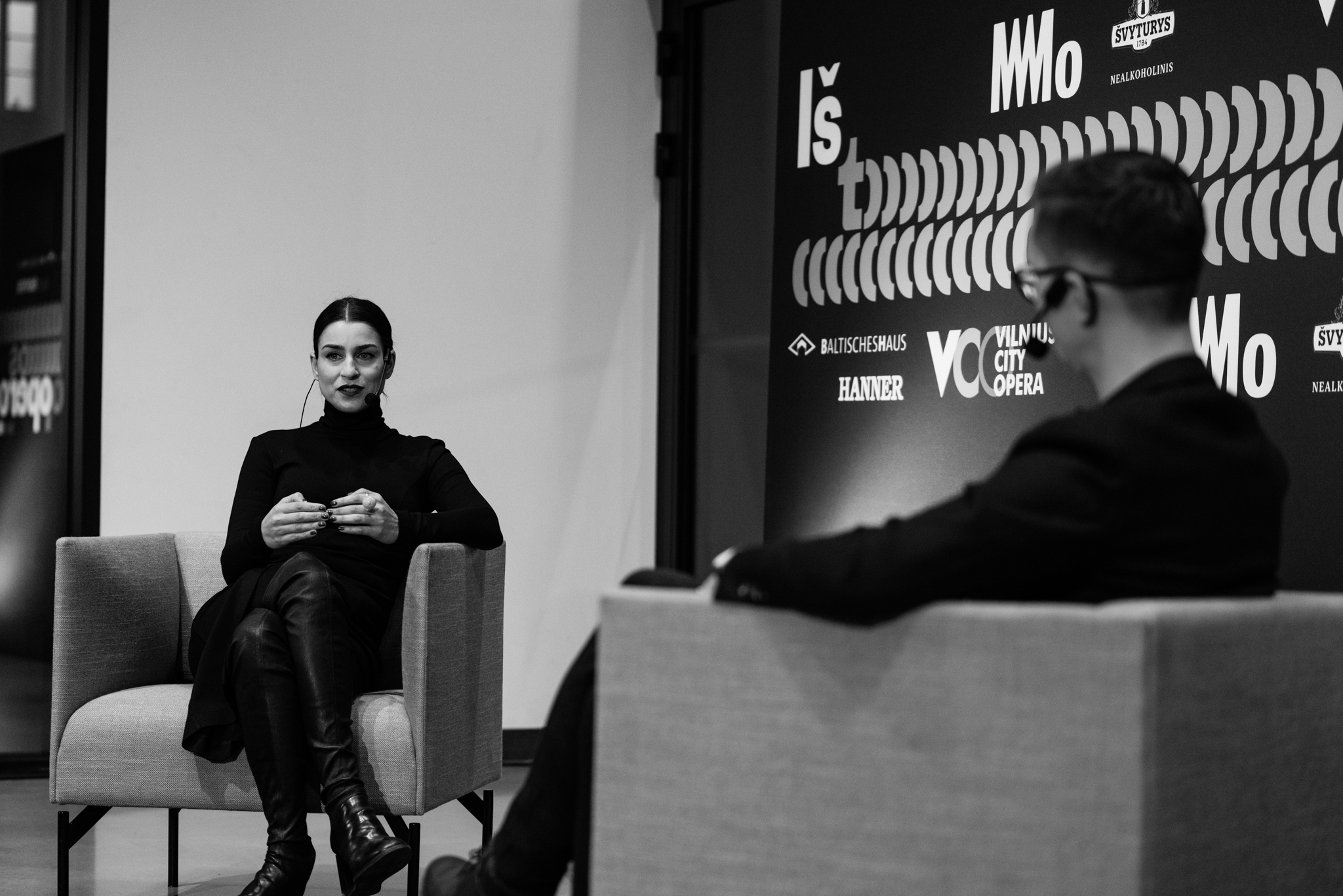
Julijus Grickevičius talks with Asmik Grigorian
Trying to introduce Asmik again is probably pointless. It would be much more accurate to say that, for the first time in a very long while, the opera soloist sat down for a thorough conversation covering almost her entire career, encompassing much more than any biographical paragraph ever could.
Julijus Grickevičius: You give many interviews. Is there a question you’ve always wanted to answer but never had the chance to?
Asmik Grigorian: No. I’m the kind of person who gets what I want, and if not… then not. Every interview is unique. Even the same question can require a completely different answer depending on the day. The conversation itself is always important to me. Ask, and I’ll do my best to answer sincerely, wholeheartedly.
Julijus Grickevičius: You and the “Bohemians” are very closely connected. If we look at your agency “Askonas Holt” biography, it mentions the Bohemians almost in the second sentence. You carry the Bohemians’ name and are one of the founders of Vilnius City Opera. What does it mean to you?
Asmik Grigorian: Once the Bohemians carried me, now I carry their name. The Bohemians have been part of my career from the very beginning, so it’s a part of my life that will always stay with me.
Julijus Grickevičius: If we look back at the past and imagine the significance of the Bohemians in your life, how would you illustrate that? In 2005 you debuted at the Lithuanian National Opera and Ballet Theatre in “La Traviata,” and in 2006 appeared in “La Bohème.” Critics greeted you cautiously, while the Bohemians offered more freedom, experimentation, and energy.
Asmik Grigorian: I’m not inclined to compare. These were two completely different experiences. For “La Traviata,” I received the Golden Stage Cross as a debutante, so it was extremely important to me. It was also a work with Jonathan Miller, with whom I had previously worked in Kristiansund, Norway. That created an emotional connection. The National Opera always marks a personal milestone for me.
The Bohemians, however, represent continuity. Over the 14 years of working together, we accomplished many major things. These two beginnings aren’t comparable, not to mention my personal bond and full trust with Dalia Ibelhauptaitė, who I call “all the way through” no matter what. This has been a 14-year shared journey with many historic achievements.
Julijus Grickevičius: What do you consider historic achievements?
Asmik Grigorian: Beyond bringing something new to opera, it was very important for me to bring in young people. My method is authenticity and sincerity. I wanted to show the younger generation and those unfamiliar with opera that it’s not just about heroes; it’s about real people, and the language of opera can be accessible to everyone. Everyone listening can find their own story in it. I think we succeeded with the Bohemians.
Julijus Grickevičius: Publicly, even young people saw you as a rockstar. In Lithuanian opera, there were two figures who stepped far beyond the genre: Virgilijus Noreika, who once sang with rapper Luku, and you, who appeared as someone more than just the opera stage or world.
Asmik Grigorian: You don’t need to perform with a rock band to be a rockstar. It’s a character trait. To attract people, especially young ones, and make them see themselves in you.
Julijus Grickevičius: Preparing for this conversation, I spoke with Dalia [Ibelhauptaitė]. She spent about half an hour telling me how all your later roles are connected to “La Bohème” and your leap from two meters up. Is that true?
Asmik Grigorian: I would say there are no easy roles. I give every role 100 percent and more. Nothing ever felt easy. I like to say life is very simple but certainly not easy.
The “Boheme” role came with a lot of fear. Not only because it was one of my first roles, or the leap from a height I truly feared, but also because it was my debut in Lithuania as the daughter of Irena Milkevičiūtė and Geham Grigorian. Nothing was easy.
Julijus Grickevičius: Fear is normal for any soloist, not only for extreme actions but even just stepping on stage. Also, mastery comes into play because there are many critics and home practice, and then there’s embodying the character. Opera is an emotional genre, usually with tragic endings: death, betrayal. Such things can be exhausting.
Asmik Grigorian: I’ve never found being in a role difficult. It’s my favorite part of my profession. In one lifetime I can live many lives. Each role profoundly grows me as a person because I truly experience everything: the pain, joy, loss of the characters. I’ve always seen it as a gift.
Fear is another matter. I have struggled with panic attacks on stage my entire life, and it remains one of my greatest personal battles. This could be a whole topic on its own: the indescribable fear that has been part of my 17-year journey. Only this year did I perform a premiere without medication, without beta blockers. It took 17 years, and the fear didn’t vanish. You just realize that your professional level is high enough to overcome it and deliver your maximum.
Julijus Grickevičius: You mentioned comparing yourself to your parents. How did you forge your own authentic path? When did you feel that Asmik Grigorian was truly Asmik Grigorian?
Asmik Grigorian: It’s hard to pinpoint. Some people in Lithuania may still compare, but globally, I am no longer compared. I’m very grateful to Dalia for wisely advising me not to sing Mimi in 2006 “La Bohème,” but to perform Musetta instead. My mother always sang Mimi, so this distinction saved me, even if I didn’t fully understand it at the time.
Julijus Grickevičius: Back then, you were working a lot: multiple productions and building an international career. One musicologist wrote: “If she polished a few opera parts like diamonds… Talents like hers are rare, but talent itself needs refining.” That’s both a recognition and a constant admonition.
Asmik Grigorian: That has accompanied me my whole life. People often don’t understand that talent cannot fit into a box. Eventually, you learn to discover yourself and refine your roles. But it takes time. If I had always followed instructions blindly, I would never have reached where I am.
Julijus Grickevičius: So your inner sense guided you. How do you know when it’s time to take on a role or take the next step?
Asmik Grigorian: I have intuition. I’ve always followed my heart. My mind plans calendars and daily schedules, which I manage well because I’ve been a mother for many years. Motherhood taught me precise planning, but I never let my mind make decisions. Life’s lesson is knowing when to tell your mind to be quiet. Decisions come from another part of the body or soul.
Julijus Grickevičius: Returning to parents, Miles Davis once said about why he started playing trumpet: “My mother wanted me to play violin, my father gave me a trumpet. Since my mother loved my father, she agreed.” How was it for you? How did your relationship with your parents develop?
Asmik Grigorian: My parents were divorced, and I grew up mainly with my mother, but I traveled a lot with my father. Seeing him less created a different, unique bond. It’s easier to love someone from afar. I had both parents, and I learned a lot from each, and I still do.
Julijus Grickevičius: You were also your mother’s student. How was it learning from her?
Asmik Grigorian: It wasn’t easy. Sometimes I wish I could have absorbed everything from her, but it was a necessary process. Even if we left the class occasionally, I still learned. She instilled in me the taste for authentic sound, which I pursue today, and I learned that from both parents.
Julijus Grickevičius: I imagine your mother helped shape your character in youth.
Asmik Grigorian: Absolutely. Just as I shaped hers. Life is never simple, but my mother managed perfectly. She always gave freedom, let me make mistakes, but was there to make sure I didn’t fall.
Julijus Grickevičius: Gradually, we approach the image of Asmik walking on a knife’s edge. It’s a trait of yours: to test limits on stage and in life.
Asmik Grigorian: Today, I wouldn’t call it walking on a knife’s edge. I always walk the borders, but you never know where the end is. You never think about being safe. That’s the essence - courage. I always say you must live life as you want. I teach my children: if you want a limitless life, you must also develop discipline and responsibility. I’ve never aimed for safety, but my heart and respect for the world prevent me from crossing others’ boundaries. I can push my own limits but try with all my heart not to cross the limits of the surrounding world.
Related news
Bohemians Turn 20: Anniversary Season to Culminate in Norma with Asmik Grigorian
Sustainability in opera: how Juozas Statkevičius’s costumes were given new life a decade later
When everything hangs in the balance on stage: the invisible heroines of Dalia Ibelhauptaitė’s productions reveal the secrets behind the scenes
How Bohemians’ advertising took to the streets and changed perceptions of opera