“Bohemians” photographer Lina Fisheye: “This will be a different kind of opera. No mothballs!
When theatre and opera director Dalia Ibelhauptaitė invited young photographer Lina Fisheye to create the first photo shoot for “Bohemians,” Lina turned the image of opera soloists upside down. “This will be a different kind of opera. No mothballs!” Dalia declared. And the photographer set about breaking the unwritten, conservative rules governing the image of opera singers.
Who could have imagined that soloists, who are always so careful to protect their voices, would wade into the cold waters of the Vilnelė River, clamber over ruins, bake in the scorching sun, and embark on the most improbable experiments? Lina was unafraid to show them differently - without pomp, without a safe distance, without the usual boundaries of the opera world. This freedom became the new face of “Bohemians.”
***
“Bohemians” are turning 20! I promised to share my memories, but memory, like an old dog, drags up only gnawed bones. I don’t want to repeat stories that have already been told.
When you wade into a river, you have to wait for your body to adjust to the coolness. Then you can swim upstream, drift with the current, and dive beneath the surface. Memories are much the same: to reach them, you have to row against time and dive to the bottom, where feelings, thoughts, and images from those days lie submerged like shells.
September 2006. I remember a whirlwind of energy and belief in the photo studio: This will be a different kind of opera. No mothballs! Everyone would want to see it - there would be queues, tickets would sell out. We had to take photographs! My first thought was: “Opera?! Who wants to go to the opera, let alone queue for tickets and find them sold out? That’s bold.” Dalia was a “Big Bang” - a force of nature from which life emerges. She was like an icebreaker, sweeping away every NO: distrust, impossibility, ignorance, lack of resources. Suddenly, we had everything: time, people, money, equipment, and an abundance of love. Belief is the greatest creative force and a gift to any artist. At the time, my photo studio in Paupys was mostly occupied with commercial projects, which had clear boundaries and practical objectives. Dalia’s dream big meant complete freedom - the kind I had always longed for. And feared. And received.
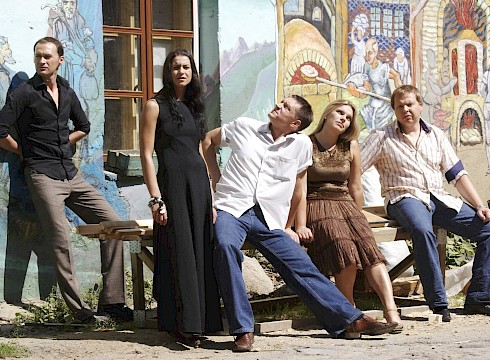
The first photo shoot was a warm-up, both for us and for the press. It consisted of portraits of the soloists in Giacomo Puccini’s La Bohème, taken in Užupis. I photographed everyone barefoot by the Vilnelė, then we ventured into the ruins where the ArMADA events used to take place. No makeup, stylists, props, or lighting. Just simplicity and authenticity, as clear as glass. Here they are - meet the people with whom a miracle is about to be created!
The premiere of La Bohème did not change my musical tastes. I had never been an opera fan, and I didn’t become one. But the cinematic power of the staging and the voices certainly captivated me. A friend of mine cried while watching La Bohème, and afterwards kept repeating that Lithuania had never seen opera of such quality!
I remember Jurga Ivanauskaitė attending one of the La Bohème premieres. Before the performance, we were each given an accessory - a fan bearing the word “Bohème.” Jurga rolled a thin cigarette in hers for a special moment (she was already suffering from cancer at the time). I wonder whether she ever lit it, and when...
After the first performance, everyone had seen Dalia’s talent. By the time she staged W. A. Mozart’s The Magic Flute, everyone believed in “Bohemians” success.
I look through the photographs and posters for La Bohème. In one, there is Rodolfo; in another, Mimì. We didn’t have the money to hire actors, so I invited my friends to portray Rodolfo and Mimì. It all still feels so alive, as if the photographs were taken just a few years ago. Yet a whole new generation has grown up since then - of soloists, conductors, directors, and photographers.
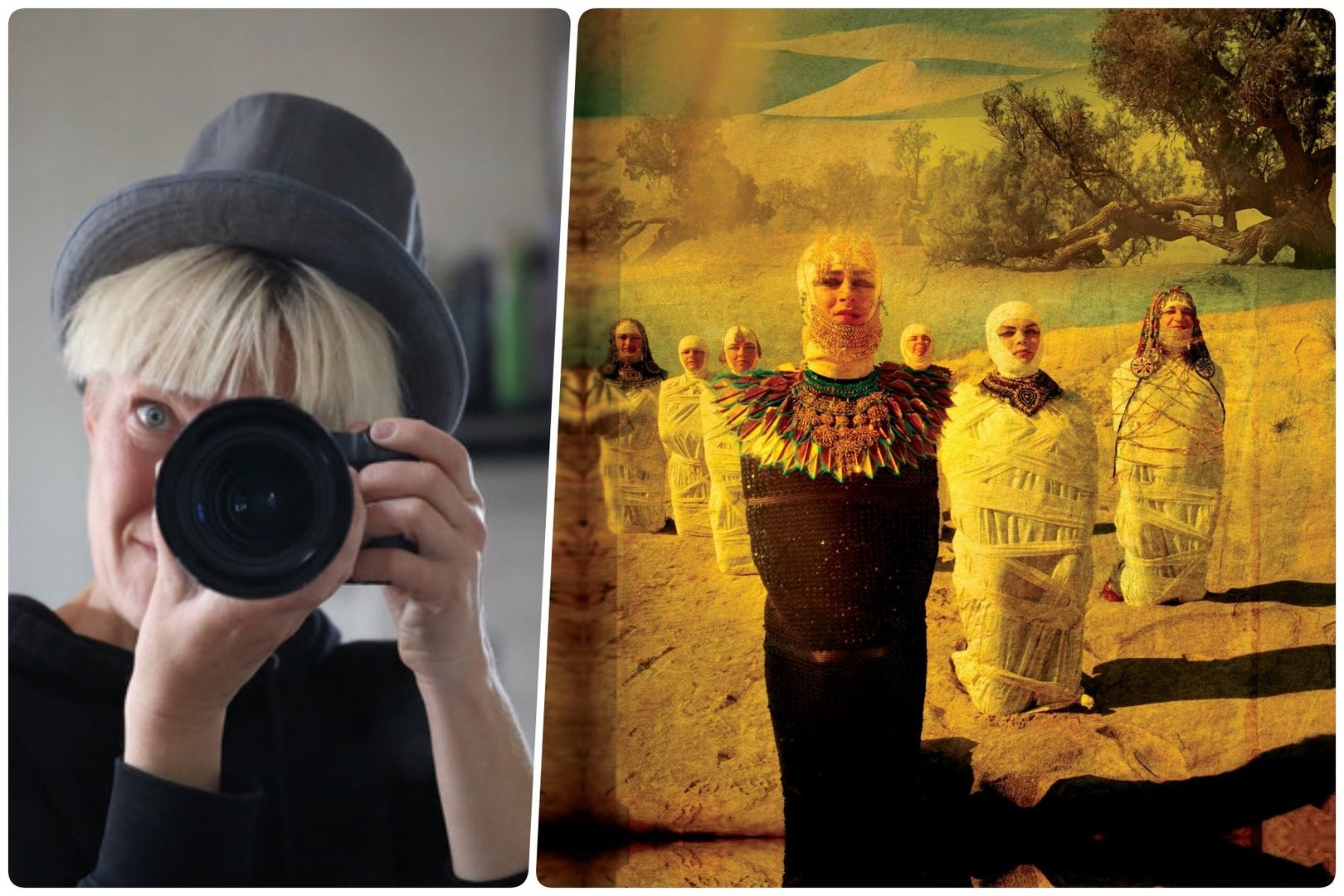
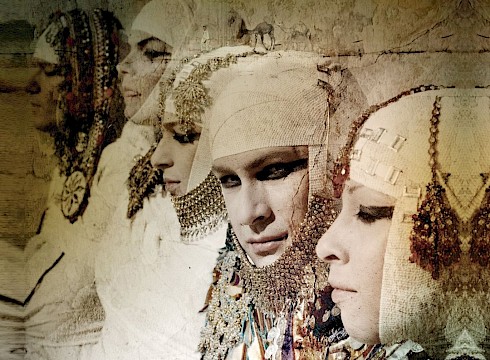
I turn the pages of the photo shoot we created in Neringa in 2007 for Mozart’s The Magic Flute. I remember that we needed special permits to photograph in the Dead Dunes. Dalia somehow conjured them up. Juozas Statkevičius came up with the idea that everyone should be wrapped like mummies. The soloists wrapped one another in sheets, wound elastic bandages around their heads, and secured them with hooks so the bandages wouldn’t unravel. I left them that way in the photographs, adding a touch of irony. Juozas brought along a mountain of accessories, dressed everyone up, and did their makeup.
There was no clear vision. What could you expect from a bunch of mummies? And on top of that, I had to manage all the technical decisions, the team, the composition, and somehow keep the meaning of The Magic Flute in focus. How could I convey through images a magical, mysterious world where light meets darkness, love meets fear, and the earthly meets the supernatural? The harsh sunlight cast deep shadows. I turned the soloists away from the sun, tried another angle, moved them back... I kept searching. I asked the mummies to move forward, to the right, closer, farther away. Every movement was complicated: the sand was heavy going, and mummies don’t walk. The autumn sun was scorching, and makeup began to run. Jewellery and sand kept tickling, pricking, or pressing against someone somewhere... We giggled. Someone wanted a drink; someone else needed an itch scratched. People walked along the crest of the dune, watching us as though we were a spectacle. We had become a performance ourselves. The soloists began to sing. Magical!
There was so much laughter and such good humour, alongside enormous inner tension - the responsibility for the final result. Feathers are light, but how difficult it is to fly. Creativity is much the same.
Meeting the soloists left an impression that has stayed with me for a lifetime. After the photo shoot, we went to the sea. Asmik Grigorian sang... The full moon was enormous. Divine.
We returned that night frozen to the bone. We had been staying at the Zunda holiday resort, and few people remember what it looked like back then. The walls were covered with varnished wooden panels, and the windows were draped with yellowed sheer and blackout curtains whose patterns were echoed in the sofa upholstery. Crocheted doilies adorned the coffee tables, and the bed linen featured tiger-skin motifs. We had some fun there, too - a little photo shoot using Zunda’s own “props.”
I returned home with hundreds of photographs of mummies and the anxious question of how to turn them into a new world - the world of The Magic Flute. For several weeks, I combined images of the Dead Dunes and the soloists with photographs of all sorts of objects and moments. In one photograph, inflated rubber gloves became cacti; in another, I inserted a Bedouin leading a camel, whom I had photographed in Morocco. I tried every filter and feature Photoshop had to offer. It’s a pity that integrated AI capabilities didn’t exist back then. Perhaps I’ll return to this idea one day and experiment with AI using the mummies of the Dead Dunes.
What fascinated me about working with “Bohemians” was their simplicity. Juozas, in particular, is incredibly easy to work with. At first, I thought, “Here we go - he’s a star...” But it was always simply perfect. He knows how to pose himself and others, understands light, and has an instinct for the moment. I remember a photo shoot with Dalia for a magazine. She arrived with Juozas after rehearsals, utterly exhausted. We stood there. No makeup artist. I had no makeup supplies in the studio, not even a comb. Juozas asked, “So, what have you got?” “A toothbrush.” “Give it to me.” He combed Dalia’s hair with the toothbrush and fashioned something out of a scarf to serve as clothing. I was just getting ready to take the photograph when Juozas said, “No, no, shoot from above - from right here.” He climbed onto a chair. “That’s it. We’ve got it!”
The economic crisis began in 2009. Things were worrying. All the “Bohemians” - the soloists, Juozas Statkevičius, Dalia Ibelhauptaitė, and Gintaras Rinkevičius - took to the streets in opera costumes, carrying stage props. The message was simple: for the theatre to survive, it needed state support. We decided to make some noise in the press. In different districts of Vilnius, we set up homes in the streets: a bedroom, a living room, a study, a bathroom - and moved in as though we lived there. I don’t know whether the campaign achieved its purpose or whether “Bohemians” received the support they had hoped for. But for me, it was a unique experience: one-off performances in which I, the photographer, was the only audience member.
Related news
Bohemians Turn 20: Anniversary Season to Culminate in Norma with Asmik Grigorian
Sustainability in opera: how Juozas Statkevičius’s costumes were given new life a decade later
When everything hangs in the balance on stage: the invisible heroines of Dalia Ibelhauptaitė’s productions reveal the secrets behind the scenes
How Bohemians’ advertising took to the streets and changed perceptions of opera