The “Bohemians” the audience never saw
Augustė Radzevičiūtė
From September 17 to 20, the first decade of the “Bohemians” will come to life on a giant screen in Town Hall Square: a young Asmik Grigorian and Edgaras Montvidas, Dalia Ibelhauptaitė’s direction, Gintaras Rinkevičius’s orchestra, and costumes by Juozas Statkevičius.
On screen, just as on stage, one thing will remain unseen: the hard, gruelling work of rehearsals and the people backstage, whose hands bring theatrical magic to life. These are the people who build, assemble and dismantle the sets.
Ahead of the twentieth anniversary of Vilnius City Opera, we spoke with two of them: set-building master Romas Pupkevičius, without whose hands not a single “Bohemian” production would have existed, and Valdas Stasiūnas, who spent a decade as part of the “Bohemians’” technical team.
2006: “No chance”
It all began with the word “no.” In the spring of 2006, Romas Pupkevičius and two colleagues had just left the Lithuanian National Opera and Ballet Theatre. After thirteen years working at the theatre, the pay system changed: the state prohibited salaries based on length of service and assigned everyone wages close to the minimum. The 2005 economic crisis had also taken its toll, performances were becoming less frequent, and the entire workshop had been reduced to just three people. “I had a good commission that needed to be completed,” Romas recalls. “I suggested to my colleagues that perhaps we should join forces. That was it - they agreed.” They spent the money they had saved on equipment and tools.
His meeting with Dalia Ibelhauptaitė and British set designer Dick Bird became their first major joint project. “The set for La Bohème was extraordinarily complicated,” the director explains. “It was being made not for a theatre, but for the Congress Hall: a two-storey structure that had to open and close in front of the audience and look like a work of art from every angle, with no visible back or ugly side. “Romas and his colleagues looked at the model, learned the premiere date and said, ‘No, there’s no chance.’ The set needed six months to build, but we had, I think, three months. He kept refusing, wouldn’t agree, said he didn’t have enough workers. And I kept persuading them, putting pressure on them in every way I could.”
Romas remembers the period in even fewer words: “I don’t remember it all that well anymore - it’s been so many years - but I think we pulled the whole of La Bohème together in about a month and a half.” “They worked themselves to the bone,” says Dalia Ibelhauptaitė. “Before the premiere, they probably worked for about fifty hours straight without sleeping. They brought in the last ladder just two hours before the performance. But it was an incredible time for us, and their calling card.
“After La Bohème, Romas built the sets for every single one of our other productions. Every last one.”
From that first La Bohème, Romas took away a principle he still follows today: “Nothing is impossible. There’s only too little money. If the funding is good, you can make practically anything. The only question is whether it’s worth the cost, because making something truly authentic can cost an enormous amount of money- and no one may even notice it.” That experience also taught him another lesson.
Dick Bird was the first set designer Romas had worked with who insisted that scenery be made to the same standard as a film set, down to the tiniest detail - even though the audience was sitting twenty metres away and would never see all those details. “We simply couldn’t understand why. We’d say, ‘Wait, nobody will see that detail.’ And he’d reply, ‘I will.’” Today, Romas says, many set designers work this way. Back then, it was something new.
A carpenter’s journey
To become the man who, twenty years later, is still building opera sets, Romas had a long road to travel. He grew up in Žvėrynas, but in 1985 their house was demolished and the family moved to Justiniškės, which was then under construction. The nearest educational institution was a vocational school. Since he had loved working with wood from childhood, he enrolled to train as a carpenter. After graduation came two years in the Soviet army. When he returned in 1990, there was no work. He spent six months training as a professional driver, even receiving a stipend while studying. Then, for two years, he drove a bus, transporting people around the city.
A friend brought him to the theatre. The friend worked at a design institute, and his manager knew the head of the theatre, which happened to need a carpenter at the time. Until then, Romas had had no connection with theatre. He had only his hobbies, which, as it later turned out, were the same craft under a different name: restoration and collecting antique weapons. Yet Romas has no doubt that the theatre was where he was meant to end up.
An eighteen-year-old from the punk-rock scene
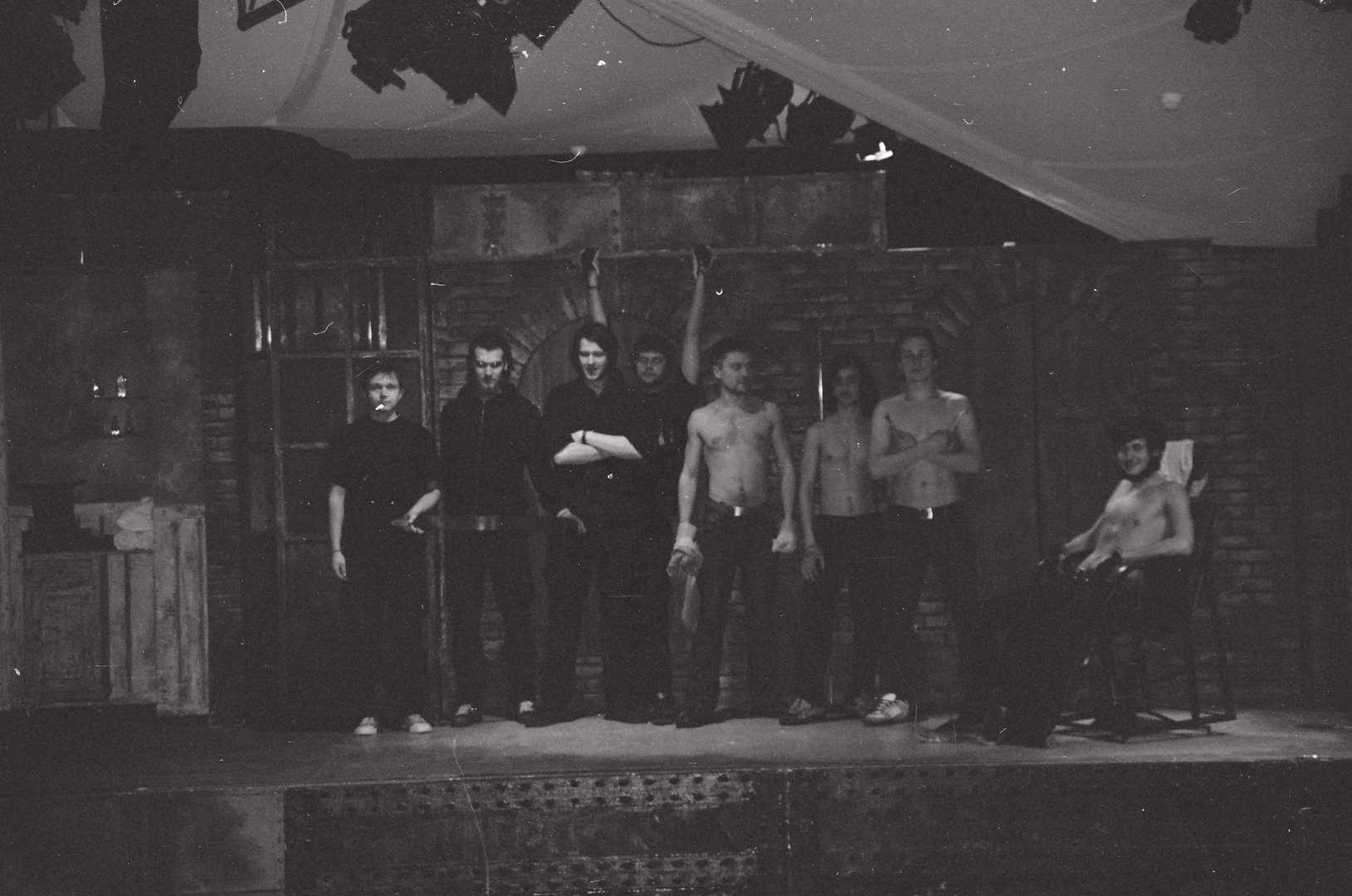
Valdas Stasiūnas, a chef and vocational teacher, arrived in the same community from a different direction: the punk-rock scene. As a student, he needed some pocket money, and his friend Mindaugas worked with sound equipment at the theatre. “Every now and then, he’d bring me along to join the technical crew. I tinkered around, tinkered around- and eventually got myself locked in for good.” Then a colleague who had previously built opera sets called him. “He said, ‘Valdas, would you like to join us?’ And I was this young, adventurous student, so I said I’d do everything I could.”
Valdas remembers that when Dalia Ibelhauptaitė saw the team he had assembled as an eighteen-year-old, she called them intellectuals and wondered how they would manage the genuinely hard physical work.
They managed just fine. “My team was amazing punk rock,” Valdas laughs. “Everyone had superpowers. One was a really good technician, another was even better. The third was incredibly strong physically, and the fourth was unbelievably funny. We even had two qualified pianists in the group.” This gave rise to a ritual nobody in the auditorium knew about. During set dismantling, two colleagues - one of them engineer Julius Grigelionis, now an award- winning sound director and recipient of the Silver Crane - would take apart the scenery from opposite sides of the stage as if they were competing in a race. One would go for a “modern” style, the other a “classical” one. The rest would sit in the audience seats and watch. “We would just sit back and enjoy the show.”
His first opera was also La Bohème. It was also the first time the technicians had to work during the performance itself, in full view of the audience, rather than only before or after it.
“There’s a huge restaurant set on stage that is sometimes covered by a fence to make it look like a street. I remember having to attach that enormous fence with carabiners. It was incredibly stressful for me. What if I didn’t hook it in the right place? Nobody was going to wait for us. We practised and rehearsed to get it exactly right, because the tension during a performance is completely different from what you feel during a technical rehearsal.”
Chess during the interval
When a performance is underway, the technicians’ work does not end. It simply moves into another phase. “During the technical rehearsal, we put everything in place. During the performance, we have intervals in which we need to change the scenery,” Valdas explains. “But, say, you can’t change everything during a thirty-minute interval. So we found ways to occupy ourselves with something else.” That something was chess. At first, Valdas played badly, and his colleagues nicknamed him “the second IBM.” So he began studying chess books at home. “Rafailas Karpis was a serious chess player. I played the most beautiful game of my life with him,” Valdas recalls.
There were also poker nights with soloist Kostas Smoriginas, and a friendship with Sigita Ivaškaitė, the stage manager, who, in Valdas’s words, always came up with ideas that would never have occurred to anyone else.
And above all, there was Asmik Grigorian. “To this day, whenever I meet someone from those days, the first thing I ask is, ‘How’s Asmik?’ We had a wonderful connection with her. She was always there with us, and I think she was everyone’s favourite soloist.”
Asked how much actual bohemian life there was in La Bohème, Valdas answers with a question of his own. “What do we mean by bohemian life? I don’t know the traditional definition.
“For me, bohemia was simply my group of technicians: what we did together, how we spent time together, how we understood one another. We didn’t need to search for words, and we never felt tense. All the hard work was accompanied by an extraordinary sense of lightness. “But when it came to work, we were extremely disciplined and focused. Whoever was responsible for something did it, regardless of what might have happened to anyone else.”
How the craft has changed
Romas also remembers a very different era. When he began working in theatre, sets were still made of wood. “I entered the profession in the 1990s, when productions looked very realistic and the sets were fairly primitive. You had a wooden frame with fabric stretched over it, which the women would paint according to the image supplied by the set designer.”
Then everything began to change. Plasterboard appeared, and Lithuanian set designers started travelling abroad more frequently, bringing back new techniques and ideas. Wood was gradually replaced by plastic, then metal, and eventually aluminium welding - which at the time seemed almost unimaginable. Today, Romas’s team scans the set designer’s model, which is always made very small, enlarges it to the required scale and prints it in plastic.
The team later spread the standards they had learned in the world of opera and ballet throughout Lithuania: pin joints that allow everything to be changed in an instant during an interval, and specific connection systems used in opera productions. What began with three men and their own machinery has grown into a team trusted to build sets for some of the country’s largest theatres, museums and events.
Sweeney Todd and sleepless nights
Asked about the most difficult moments, both men immediately recall the same production: Stephen Sondheim’s Sweeney Todd: The Demon Barber of Fleet Street, which audiences will once again be able to see in Town Hall Square on September 19. For the technicians, it meant a week without proper sleep: building the set, working through all the performances, dismantling everything overnight, and then putting up an entirely different, minimalist set the next day.
“There were stretches when we didn’t sleep at all for two days,” Valdas remembers. After one such touring trip between Kaunas and Klaipėda, he was driving back in the middle of the night. “I had to call the technicians and tell them to gather near the Green Bridge at three in the morning, dismantle everything and load it onto the truck. I called and said, ‘Vilius, keep an eye on the wheel for me. I need to make a phone call.’
“I don’t know how long I slept while Vilius drove from the passenger seat.” On another occasion, he nodded off on his way home while stopped at a red traffic light. When he opened his eyes, a police officer with flashing lights was already standing beside the car, asking why it wasn’t moving. “I said, ‘I’m just making a precautionary stop…’”
For Romas, those nights never really end. “Even my wife complains that I don’t know how to relax, that I live at work. You lie down and you’re still thinking about what you’ll have to do tomorrow, what you’ll have to do in a week.
“The deadline is the worst thing about this job. Nobody cares whether it’s a holiday or a day off. The set has to be finished on that exact day, at that exact hour.” Experience has taught him about another, less obvious difficulty: when the set designer cannot make up their mind about what they want and tries to shape the final version directly through the hands of the craftspeople.
Once, such indecision cost him an entire week. The designer kept postponing the delivery of the model, adding another pencil line each time. “I’d ask, ‘Can I take the model now?’ But whenever he handed it over, he’d see it from a new angle and start reconsidering it. All that back-and-forth cost us another week of the designer’s deliberations.”
Valdas associates the most complicated set change with another opera: Eugene Onegin. “When the interval began, it was our time - the biggest changes had to happen then. We rehearsed them with stopwatches in our hands, asking how many more seconds we could squeeze out of the interval. “We would get into a low starting position, ready to go: everything laid out, screws in our mouths, tools in our pockets. We would finish drenched in sweat.” Dalia even asked the technicians to make their movements poetic, ensuring that they were not angular and that everything happened in synchrony.
Taking a bow
There are moments that audiences sitting in the auditorium or the square never get to see. One of them comes two hours before a performance. “You stand on the set in the Congress Hall and look out at the empty - completely empty - auditorium. You realise that soon it will be full of people, but for now there’s just one orchestra musician tuning an instrument. It’s a unique feeling. We had the opportunity to experience moments like that often, while people never even think about them,” says Valdas Stasiūnas.
Once, during the premiere of Sweeney Todd, Sigita Ivaškaitė came up with something that had not been included in the programme. “After the premiere, when everyone was taking their bows, she said, ‘Technicians, stay here. Come out!’ I asked, ‘Us? The technicians? We’re going out there?’ “She seemed to have planned for one half of the technical team to come out from one side of the stage and the other half from the opposite side. We bowed alongside the performers, and the entire auditorium applauded us.” Even now, Valdas struggles to find words to describe the feeling. “It was the only time I felt that the audience saw you as part of the whole thing - alongside the director and the soloists. It was indescribable. To be honest, that was enough. We didn’t ask for anything more. We were simply enjoying the creative process, which people usually never get to see.”
Romas describes his place in this hierarchy without any illusions. “We are the executors; the creator is the set designer. The designer uses our hands to try to make what they imagine.” His own satisfaction comes earlier and more quietly: during the final dress rehearsal or on the night of the premiere, when he can finally look at the completed work from the audience’s side of the auditorium.
Scars
The craft leaves other marks, too - ones nobody sees beneath a shirt. Romas remembers one summer when the workshop was so hot that he worked wearing nothing but shorts. “The team gathered to discuss something. I walked over and joined the conversation, accidentally leaning against a vice. A colleague had been heating a piece of metal with a torch until it glowed red, so the edges of the vice were burning hot, too.
“It was so hot that when you touched something, you couldn’t even tell what it was. By the time I smelled burning flesh, I hadn’t even had time to understand what was happening.” The burn ran across his entire thigh. He tells the story without drama: such incidents are not uncommon in this line of work, he says, and over time you even get used to them.
What remains
Asked what he has taken away from those ten or twenty years, Valdas struggles to find the words. “It’s very difficult for me to measure it. Culturally, it enriched me immensely - not just through the works themselves, but through the people I met, both from Lithuania and abroad, and through all the conversations and connections. “I also picked up a lot of practical skills that are hard to put a value on. I know how to untwist wire, tighten a nut, and all sorts of other little things. “I think a large part of the person I am today is who I became while working with the ‘Bohemians’.”
“Bohemians - 20” events in Vilnius Town Hall Square, free admission. September 17, 8 p.m. - La Bohème; September 18, 8 p.m. - Werther; September 19, 7 p.m. - Sweeney Todd: The Demon Barber of Fleet Street; September 20, 7 p.m. - Il Trovatore.
Discussions and meetings will take place one hour before each screening, followed by reflections from musicologists 15 minutes before the start. The project is funded by Lithuanian Council for Culture and Vilnius City Municipality.
Related news
Bohemians Turn 20: Anniversary Season to Culminate in Norma with Asmik Grigorian

Sustainability in opera: how Juozas Statkevičius’s costumes were given new life a decade later
When everything hangs in the balance on stage: the invisible heroines of Dalia Ibelhauptaitė’s productions reveal the secrets behind the scenes
How Bohemians’ advertising took to the streets and changed perceptions of opera